Biokovo Nature Park: the mountain with its feet in the sea and its brow in the clouds
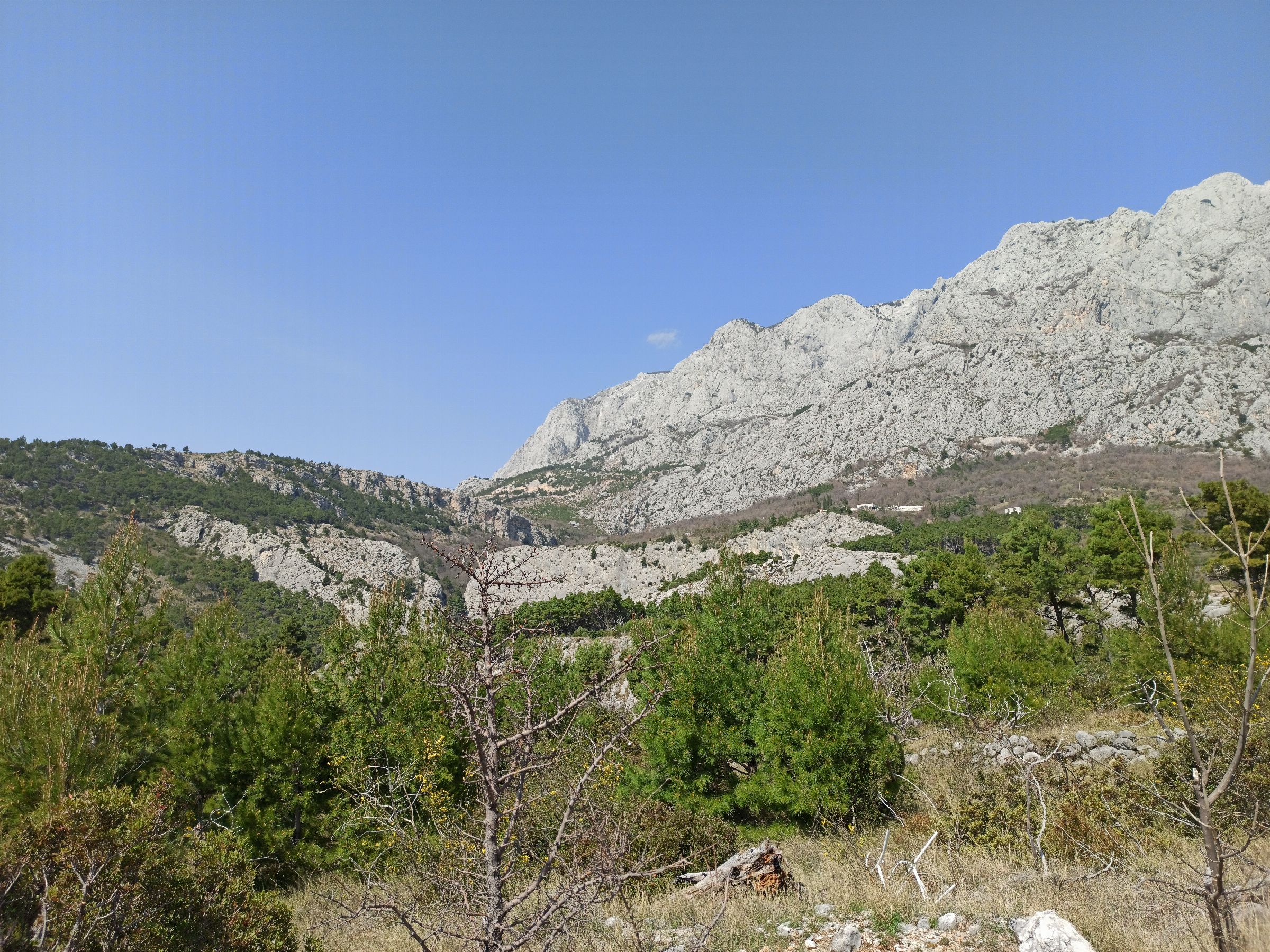
Of Biokovo the locals say that it has its feet in the sea and its brow in the clouds — and it is hard to think of a better description. This vast stone mountain rises almost vertically above the Makarska Riviera, so that from the beach you look up at peaks that climb, in just a few kilometres, to nearly one thousand eight hundred metres. Rarely in Europe do the sea and a high mountain stand so close to one another; it is precisely that dramatic meeting of the Mediterranean and the highlands that makes Biokovo one of Croatia's most impressive landscapes.
Protected as a nature park, Biokovo is the second-highest mountain range in the country, right after Dinara. Its nearly two hundred square kilometres of karst hide peaks, cliffs, caves, endemic flora and views that on a clear day reach all the way to the Italian coast. It is not a national park, but in beauty and wildness it lags behind none — and it offers something no other Croatian park has: the feeling that, by climbing from the beach to the peak, you have passed in a single day from the Mediterranean to a high mountain.
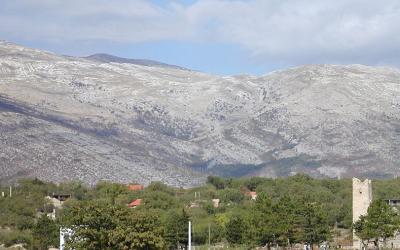
 The stone massif of Biokovo above the Adriatic coast. Photo: Wikimedia Commons, licence CC BY-SA 4.0
Sveti Jure: the roof of Dalmatia
The highest peak of Biokovo is Sveti Jure (St George), which rises to 1,762 metres, making it the second-highest peak in Croatia, right after Dinara. From its summit, on an exceptionally clear day, the view reaches unbelievably far — across the whole central Adriatic and its islands, all the way to the Italian coast and Monte Gargano, more than two hundred and fifty kilometres away.
At the very summit stands a powerful transmitter, and a winding mountain road leads to it, climbing from the sea through ever colder and harsher regions. The ascent of Sveti Jure, whether on foot or by bicycle, is one of the greatest challenges and greatest rewards in the Dalmatian highlands — so demanding that it has even been included in professional cycling races. A little lower, but equally magnificent, rises the peak of Sveti Ilija, while the whole massif is scored with rocky ridges and dizzying cliffs.
Skywalk Biokovo: a walk over the abyss
In recent years Biokovo has gained an attraction that draws visitors from all over the world — the Skywalk Biokovo, a glass sky-walk. At the Ravna vlaška site, from the edge of a cliff, a semicircular platform with a glass floor juts out into the void, beneath which opens a chasm more than one thousand two hundred metres deep.
To step onto that glass is to see, through the transparent floor, a landscape opening beneath your feet that falls straight toward Makarska and the sea. For those who are not afraid of heights it is an unforgettable experience, a blend of adrenaline and one of the finest views of the Adriatic. The Skywalk has turned Biokovo from a forgotten mountain into one of the most sought-after destinations of the Dalmatian hinterland.
Stone, caves and the karst world
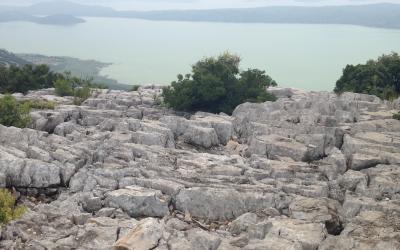
Biokovo is a textbook of karst. The whole mountain is built of limestone and dolomite, carved by rain and wind into countless forms — karren, sinkholes, rock pools and chasms. More than four hundred speleological features have been recorded in it, among them deep pits and caves that still attract explorers of the underground today.
That karst relief is not only beautiful but also harsh: water here quickly disappears into the underground, so the mountain, despite abundant rains, is dry and bare on the surface. It was precisely that scarcity that shaped both the plant world and the way of life of the people who for centuries grazed their flocks on Biokovo and built stone dwellings, fighting the rock for every scrap of fertile land.
Endemic flora and the botanical garden
Despite its apparent bareness, Biokovo is a botanical treasure. Because of the great difference in altitude — from the sea to nearly one thousand eight hundred metres — the mountain has vegetation zones alternating from Mediterranean to mountain, and around one thousand five hundred plant species have been recorded. Many are rare, relict or endemic, and the best-known among them is the Biokovo bellflower, a delicate endemic that grows only here.
To bring that wealth closer to visitors, on the slopes of the mountain, at Kotišina above Makarska, a botanical garden has been laid out — a protected area of Mediterranean vegetation with olives, sage, rosemary and lavender, especially beautiful in spring when everything blooms. A short, easy trail through the garden is a perfect introduction to Biokovo's flora for those who do not want a demanding climb.
Chamois, eagles and wilderness
Biokovo is also a refuge for wild animals. Chamois, perfectly adapted to the vertical terrain, move across its steep cliffs, and birds of prey circle the sky — eagles and falcons that nest on inaccessible rocks. In the more forested, eastern parts of the mountain live wolves too, along with numerous smaller animals, reptiles and bats that inhabit the Biokovo caves.
That fauna is part of the reason the mountain is protected: Biokovo is one of the last large, relatively untouched habitats in this part of Dalmatia, a place where the wilderness begins just a few kilometres above the crowded beaches.
The bura, the climate and two worlds
Biokovo is a mountain of two worlds. Its coastal slope, facing the sea, is sun-drenched and under the influence of a mild Mediterranean climate, while the inner, continental side is colder and harsher. On the peaks a true mountain climate reigns, with snow that lingers for months.
Over it all watches the bura — a fierce, cold wind that plunges from the peaks toward the sea and can reach enormous speeds, shaping both the landscape and life beneath the mountain. It is precisely because of that variability that Biokovo demands respect: the weather at the summit can change in an instant, so even a summer outing calls for warm clothing and caution.
Through the seasons
Biokovo changes its face with every season. Spring is magical — the slopes bloom, the botanical garden becomes fragrant, and the temperatures are ideal for ascents. Summer brings heat on the coast but a pleasant coolness on the peaks, so Biokovo is a perfect escape from the crowded beaches; still, the sun on the bare karst is merciless, so water and a hat are essential. Autumn brings clear air, warm colours and the furthest views. Winter covers the mountain with snow and hands it over to the bura; the higher parts are then accessible only to the experienced and well-equipped.
Life beneath the mountain
Biokovo is not only wilderness — it is also a landscape that people inhabited and shaped for centuries. On its slopes, between the sea and the peaks, numerous villages once stood, whose inhabitants grazed flocks, grew olives and vines and built houses, terraces and drystone walls from the rock by hand. Life was hard: water was scarce, the bura lashed, and every scrap of fertile land had to be wrested from the karst.
Today many of those villages are abandoned or resettled closer to the coast, but their traces — stone houses, little churches, herders' dwellings and paths — still testify to that struggle between man and mountain. The educational trails in the park, such as the one explaining traditional shepherd life, try to save precisely that story from oblivion. To walk them is to understand that Biokovo is not only a geological spectacle but also a place of deep human history.
A mountain of challenge
Biokovo has always been a mountain to be conquered. Its steepness and height make it a serious challenge for hikers, and in recent years for cyclists too — the ascent of Sveti Jure, from sea level to the summit, is among the hardest climbs in the region and has even been included in professional cycling races. The winding road that climbs the cliff is an experience in itself for many drivers.
That reputation of a demanding but majestic mountain gives Biokovo a special status in the hearts of Dalmatians. It is not a park you pass through in passing; it is a peak that is remembered, a goal that is planned and a view that is earned by effort. That is precisely why the Skywalk, which made Biokovo's beauty accessible to all, has not diminished its greatness — it has only opened it to a wider circle of people.
A few curiosities to close
Biokovo hides facts that surprise even local visitors. From the summit of Sveti Jure, on an exceptionally clear day, one can see the Italian coast and Monte Gargano more than two hundred and fifty kilometres away. The mountain counts over four hundred explored speleological features, which makes it a true paradise for explorers of the underground. Its endemic, the Biokovo bellflower, grows nowhere else in the world. And the glass Skywalk hangs over a chasm more than one thousand two hundred metres deep, which makes it one of the most spectacular viewpoints in this part of Europe.
All this makes Biokovo a park that unites extremes — sea and summit, gentleness and wilderness, ancient shepherd life and a modern attraction — in a way few mountains can.
A nature park, not a national park — what's the difference
Biokovo is a nature park, not a national park, and that difference is no accident. Unlike strictly protected national parks, in nature parks human life and certain economic activities are permitted — agriculture, livestock-keeping, tourism — as long as they do not endanger the area's fundamental values. Because of this Biokovo is a living landscape in which natural wilderness is interwoven with tradition and the everyday life of the settlements beneath it.
For the visitor this means a richer, more layered experience: alongside the stone peaks and endemic flowers, here you will also come across olive groves, vineyards, taverns and villages with a soul. Biokovo is thus not only a natural monument but a cultural landscape — a mountain that belongs both to the wild goats and to the people who have lived beneath it for centuries.
A practical guide to visiting
- Getting there. The park lies above Makarska, along the Adriatic highway, about an hour and a half's drive from Split. The entrance to the Biokovo road is above Makarska; from there a narrow, winding road leads toward the Skywalk and the summit of Sveti Jure.
- Tickets and driving. An entrance ticket is charged for the park road and the Skywalk. The road is narrow and demanding, with a limited number of vehicles; in summer an early arrival or organised transport is recommended.
- Skywalk. The glass platform is the main attraction; check the opening hours and conditions (it can be closed during a strong bura).
- Trails. For an easy tour the botanical garden in Kotišina and a shorter educational trail are ideal. For hikers, the ascents of Sveti Jure and Vošac are demanding and require good fitness and gear.
- Footwear and gear. Sturdy shoes, water, sun protection and a warmer layer for the summit are essential — the temperature difference between the sea and the peak is large.
- Rules. Move on marked trails and the road, do not leave litter and follow the weather forecast because of the bura and sudden weather changes.
- Combine with the surroundings. The Makarska Riviera with its beaches, nearby Omiš and the river Cetina, and the island of Brač just offshore make Biokovo a perfect blend of sea and mountain.
Conclusion
Biokovo is proof that the greatest experiences are sometimes hidden just above the busiest beaches. While thousands of bathers sunbathe in Makarska, you need only head upward and, in less than an hour, find yourself in an entirely different world — cold, stony, majestic, with a view that reaches to other countries. Whether you step onto the glass of the Skywalk, walk through the botanical garden or conquer Sveti Jure, Biokovo stays with you as the mountain that truly has its feet in the sea and its brow in the clouds.