Vrana Lake Nature Park: Croatia's largest lake and a bird paradise by the sea
Right beside the Adriatic coast, between Zadar and Šibenik, hides an expanse of calm water met nowhere else in Croatia — Vrana Lake (Vransko jezero), the largest natural lake in the country. Separated from the sea by only a narrow belt of stony hills, it lies like a vast mirror surrounded by reed beds, fields and vineyards, just a few hundred metres from the salt waves of the Adriatic. That unusual meeting of a freshwater lake and the sea makes it one of the most interesting natural phenomena of the Croatian karst.
Protected as a nature park, Vrana Lake is above all a bird paradise. Its reed beds and shallows are home and a resting place to more than two hundred and forty bird species, which is why the north-western part of the lake has been declared a special ornithological reserve and included on the most important international lists of wetland habitats. In addition, the lake and its surroundings are a true destination for recreation — with cycling trails around the shore, viewpoints and a peace that draws all those seeking nature far from the crowds.
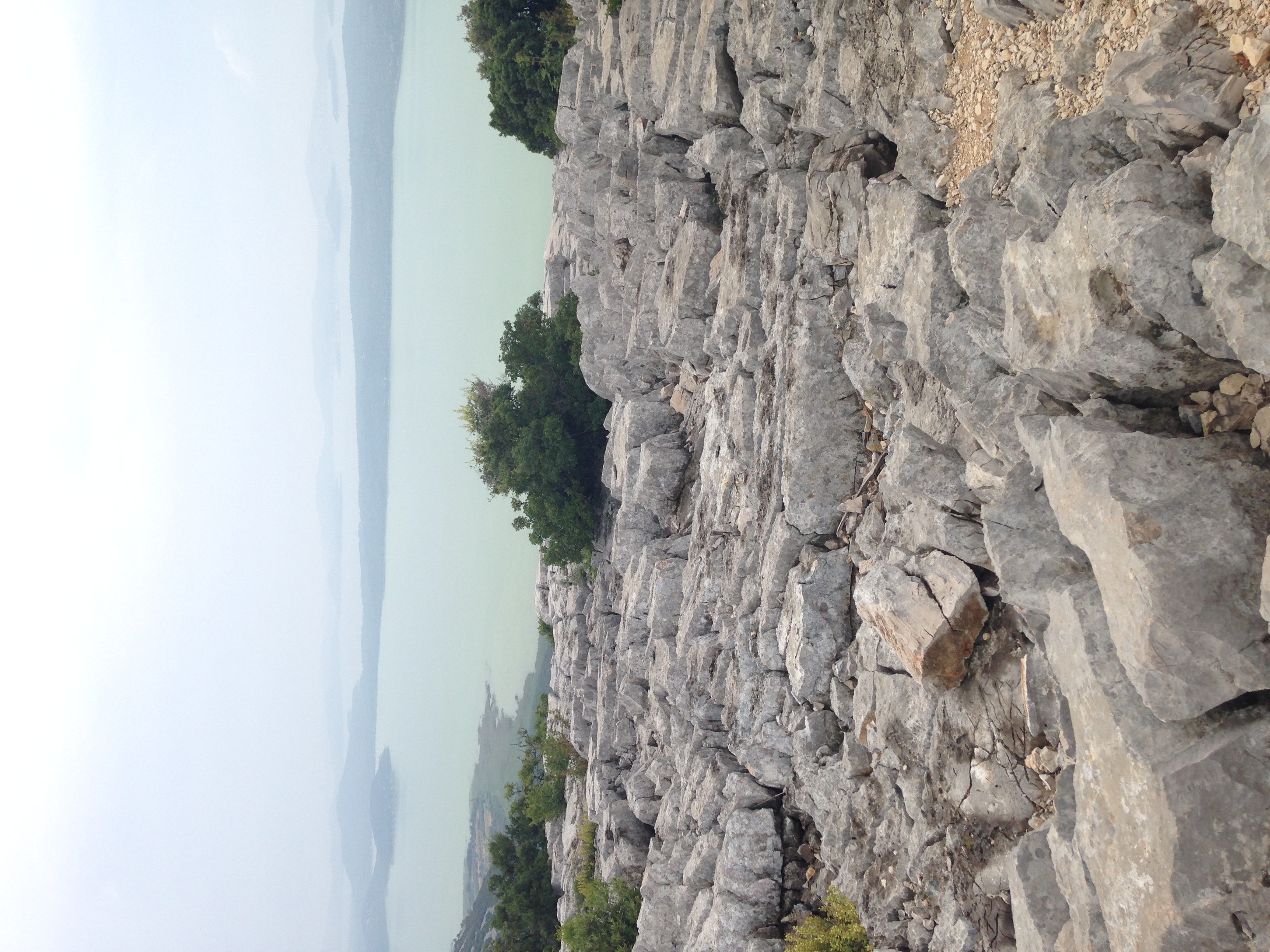
 Vrana Lake from the Kamenjak viewpoint. Photo: Wikimedia Commons (source file)
A lake below sea level
Vrana Lake is a geomorphological rarity. It is a cryptodepression — a lake whose bottom lies below sea level, although its surface is only slightly above it. It formed in a karst field that was gradually flooded with water, and it is separated from the nearby sea only by a narrow ridge of stony hills.
That nearness to the sea gives the lake another peculiarity: its water is not entirely fresh but slightly salty (brackish), because the lake is connected to the sea by underground routes and an artificial channel. Because of this, both freshwater and marine fish species live in it — a combination that is exceptionally rare. Vrana Lake is thus at once a lake and, in a way, an extension of the sea, a unique ecosystem on the border of two worlds.
The ornithological reserve: a home for thousands of birds
Vrana Lake's greatest treasure is hidden in its reed beds on the north-western side, where one of the last great Mediterranean wetland habitats on the eastern coast of the Adriatic stretches. This area has been declared a special ornithological reserve — a refuge in which an incredible number of birds nest, winter or rest on migration.
More than two hundred and forty species have been recorded here, among them rare and endangered ones, such as herons, spoonbills, grebes and various species ever scarcer elsewhere in the Mediterranean. For birdwatchers the lake is a true place of pilgrimage, especially at migration time, when huge flocks gather in the reed beds and shallows. Arranged observation towers and educational trails make it possible to see that hidden world up close without disturbing the birds.
Kamenjak: a breathtaking view
If Vrana Lake has one point from which it is best experienced, it is the Kamenjak viewpoint. From the top of that stony hill on the south-western side of the lake opens a view remembered for a lifetime: on one side the whole expanse of the calm lake, and on the other, across a narrow strip of land, the blue of the Adriatic with the scattered islands of the Kornati.
That double sight — lake and sea in one view — makes Kamenjak one of the loveliest viewpoints on the whole Dalmatian coast. Arranged trails lead to it, and at the top are observation platforms and information boards. For many visitors it is precisely the climb up Kamenjak that is the highlight of a visit to the park, the moment in which one grasps how unusual and beautiful this meeting of lake, land and sea is.
Fish, eels and the fishing tradition
Vrana Lake has fed the people along its shores for centuries. Thanks to the mix of fresh and salt water, it is rich in fish — from freshwater species such as carp and pike to marine ones that enter through the channel, and especially prized eels and mullet. The fishing tradition here is long and deeply rooted in the life of the surrounding settlements.
Today fishing on the lake is regulated and part of the careful management of the park, which must reconcile the protection of birds and habitats with tradition and recreation. Still, the story of the fish and the fishermen is part of the identity of this region, a reminder that Vrana Lake is not only a natural reserve but also a landscape that people have used and loved for centuries.
Cycling around the lake
Vrana Lake is an ideal destination for an active holiday. Around the whole lake runs a cycling trail dozens of kilometres long, leading through reed beds, fields and small settlements, offering views of the water and a chance for birdwatching along the way. The flat terrain makes it accessible to almost everyone, from families to fitness enthusiasts.
Alongside cycling, the park also offers walking trails, observation towers, and in certain places the chance to swim and enjoy the peace by the water. Thanks to the nearness of the coastal tourist resorts, such as Pakoštane and Biograd, Vrana Lake is a perfect escape from the summer crowds — a place where, just a few minutes from the beaches, you plunge into an entirely different, calmer world.
Landscape and plant world
Around the lake and in its waters a rich plant world has developed, adapted to damp and brackish conditions. The vast reed beds that surround the north-western part of the lake are not only a bird habitat but also a natural filter that purifies the water, while on the surrounding hills stretches typical Mediterranean vegetation — maquis, olive groves and vineyards.
That mosaic of habitats — from open water and reeds to dry stony slopes — is the reason the lake can feed so many different species. It also gives the landscape its recognisable beauty: the blend of the watery, almost wistful calm of the lake and the dry, sunny Dalmatian hinterland that surrounds it.
Through the seasons
Vrana Lake is loveliest outside the peak of summer. Spring and autumn are the time of great bird migrations, when the reed beds are liveliest and the temperatures pleasant for cycling and walking — many consider these the best times to visit. Summer is warm and dry, ideal for combining the lake and the nearby beaches, although nature is then calmer and there are fewer birds. Winter is mild but windy; the lake then becomes a refuge for wintering birds, and the landscape takes on a quiet, wistful beauty.
Vrana: history along the shore
A rich history is tied to Vrana Lake too. Not far from the shore lies the settlement of Vrana, which was for centuries an important strategic and religious centre — the seat of the Knights Templar, and later the Hospitallers (Knights of Malta), who ruled this region in the Middle Ages. Important roads passed through Vrana, and its name carried weight in the history of all Dalmatia.
A special jewel is the Mašković han, a lavish stone building from the Ottoman period, considered one of the westernmost preserved monuments of Ottoman architecture in Europe. Today restored and turned into a cultural-tourist facility, the han testifies to times when this area was a boundary of empires and cultures. That historical dimension gives a visit to Vrana Lake added depth — alongside nature, here one also reads the turbulent past of the Dalmatian hinterland.
Why visit Vrana Lake of all places
In Dalmatia, where everything breathes of the sea, Vrana Lake offers something unexpected and refreshingly different — an expanse of calm fresh water, the silence of the reed beds and a wealth of birds, all within reach of the crowded beaches. For those who love nature, birdwatching, cycling and peace, the lake is a true discovery, and its nearness to the tourist resorts makes it perfect for a day escape from the summer crowds.
In addition, a visit is easily combined with discovering the whole region — the nearby beaches, the Kornati islands, historic Vrana and Dalmatian gastronomy. Vrana Lake is thus not only a natural reserve but an entrance into a layered, rich region, proof that even in the heart of touristy Dalmatia hide places that are quiet, authentic and full of life.
A few curiosities to close
Vrana Lake abounds in peculiarities. It is the largest natural lake in Croatia, and also a cryptodepression — a lake whose bottom lies below sea level. Its water is slightly brackish, so freshwater and marine fish live in it together. In its reed beds more than two hundred and forty bird species have been recorded, which is why part of the lake is under the strictest ornithological protection. And from the Kamenjak viewpoint both the lake and the sea with the Kornati islands can be seen in a single view.
All this makes Vrana Lake a park of unique contrasts — a place where fresh and salt, lake and sea, nature and history merge into a landscape without equal in Croatia.
A practical guide to visiting
- Getting there. The park lies along the coast, between Zadar and Šibenik, near the settlements of Pakoštane and Biograd na Moru; it is easily reached from the Adriatic highway and the motorway.
- Tickets and information. Certain facilities (the ornithological reserve, the viewpoint, guided tours) are charged; seek information at the park visitor centres.
- Birdwatching. The best time is spring and autumn; bring binoculars and visit the arranged observation towers in the ornithological reserve.
- Kamenjak viewpoint. Do not miss the climb up Kamenjak for the view of the lake and the Kornati; bring water, as the ascent is sunny and without shade.
- Cycling. The trail around the lake is flat and suitable for all; bicycle rental is possible in the surrounding settlements.
- Rules. Move on marked trails, respect the strict protection of the ornithological reserve and do not disturb the birds.
- Combine with the surroundings. The beaches of Pakoštane and Biograd, the Kornati islands and historic Vrana with the remains of former fortresses make Vrana Lake a perfect part of a Dalmatian journey.
Conclusion
Vrana Lake is one of those places that surprise even local visitors — the largest natural lake in Croatia, hidden right beside the sea, with water that is half fresh and half salt and reed beds full of birds. It combines the seemingly incompatible: lake and sea, peace and an abundance of life, recreation and strict nature protection. Whether you watch herons from a hide, cycle along the shore or climb Kamenjak to take in the lake and the Kornati in a single view, Vrana Lake will reveal to you a calmer, more hidden face of Dalmatia — one that many are yet to discover.