Dinara Nature Park: the roof of Croatia and the turquoise source of the Cetina
There is a mountain that gave its name to an entire mountain group. Dinara is so important that the Dinarides are named after it — a vast mountain system stretching through several countries of south-eastern Europe. And at the heart of that system, on the border of Croatia and Bosnia and Herzegovina, rises the summit of Dinara itself, Sinjal, which at 1,831 metres holds the title of the highest peak in Croatia. To stand on it is to stand on the roof of the country.
Long neglected and unprotected, Dinara was finally declared a nature park in 2021, giving Croatia one of its most magnificent protected landscapes. The park covers not only the bare, stone massif but also something entirely opposite — the turquoise source of the river Cetina, fertile karst fields and the upper course of that river. Dinara thus unites extremes: harsh high-altitude wilderness and a lush, water-rich world at its foot, making it one of the most contrasting parks in the country.
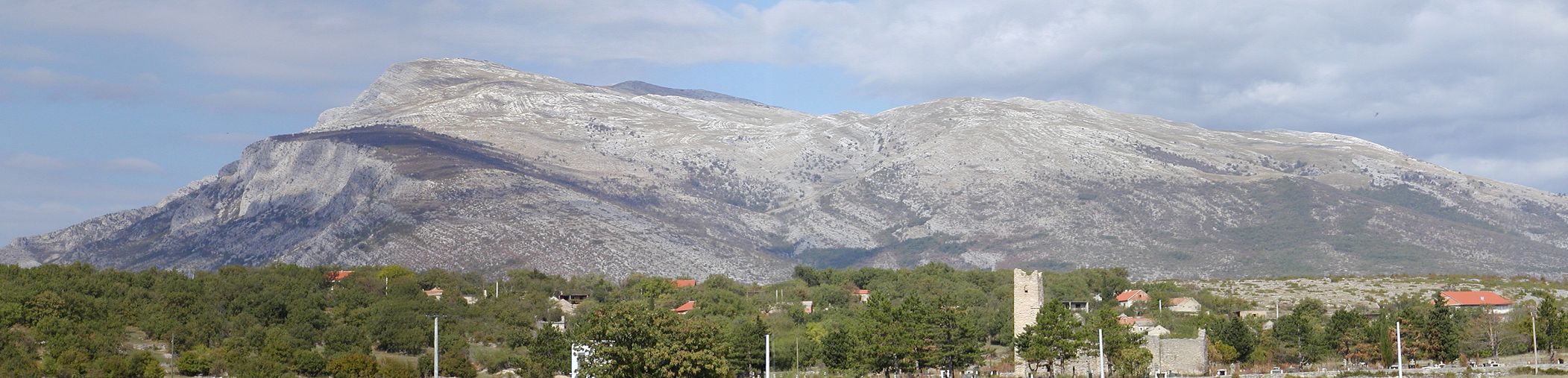
 The stone massif of Dinara above the upper course of the Cetina. Photo: Wikimedia Commons (source file)
Sinjal: the highest peak in Croatia
The crown of the park and of the whole country is Sinjal (also known as the peak Dinara), which at 1,831 metres rises right on the border with Bosnia and Herzegovina. For hikers it is a kind of holy grail — a peak every serious Croatian hiker wants to conquer at least once. From it, on a clear day, an endless view opens across the Dalmatian fields, the neighbouring mountains and, in the distance, all the way to the sea.
The ascent of Sinjal is not easy: it leads through a bare, stone high-altitude landscape exposed to sun, wind and sudden changes of weather. But it is precisely that harshness that gives it value. To conquer the roof of Croatia is to earn a view that is not forgotten — and the feeling of having touched the highest point of the whole country.
The source of the Cetina: the eye of the earth
If Sinjal is a symbol of height, then the source of the Cetina is a symbol of depth and beauty. At the foot of Dinara, from a karst spring, the river Cetina rises — and in a way that takes the breath away. The source is in fact a deep, almost perfectly round pool of an unbelievable turquoise colour, so deep that its bottom is lost in darkness. Because of its appearance it has been dubbed the "eye of the earth" or "the blue eye", and its depth exceeds a hundred metres.
That turquoise source is one of the most photogenic sights in all of Dalmatia and a true contrast to the harsh massif above it. Beside the source stands an old stone church, adding a dose of ancient, almost mystical silence to the scene. For many visitors it is precisely the source of the Cetina that is the reason for coming to the park — a place where water, stone and sky merge into an unforgettable picture.
The Cetina: a river born beneath the mountain
From that turquoise eye is born the Cetina, one of the most beautiful and important rivers of Dalmatia. In its upper course, which belongs to the park, it winds through karst fields, feeding the fertile earth and creating a green belt of life in an otherwise dry, stony region. Later, beyond the park's boundaries, it will carve deep canyons and finally, at Omiš, descend into the sea.
The Cetina has for centuries been the lifeline of this region — a source of water, food and energy. Its upper course, with the source, forms the "wet" face of Dinara, the one that balances the harshness of the heights. Thanks to this river, the park is not only a mountain but a complete landscape, from the stone peaks to the river born beneath them.
Karst fields: the veins of life
Some of Dinara's greatest treasures are hidden precisely in its karst fields — Hrvatačko, Paško and Vrličko — vast, flat plains surrounded by mountains, formed by the dissolving of limestone. These fields, unlike the bare high-altitude karst, are a true oasis of life: fertile earth, damp meadows, streams and sinkholes make them a habitat rich in plants, birds and other animals.
It is precisely the fields, and not the bare peaks, that are the biologically richest part of the park. They are also the centuries-old home of the people who cultivated them, grazed their flocks and built villages on their edges. The karst fields thus give Dinara a warm, inhabited dimension — a blend of wilderness and traditional life that is the mark of nature parks.
Harsh high-altitude wilderness
The high-altitude parts of Dinara are an entirely different world — a world of bare stone, wind and silence. At those heights, exposed to sun and bura, life is scarce and hard; the high-mountain fauna is rare but adapted. Yet it is precisely that harshness that gives Dinara its grandeur: endless stone expanses, karren and sinkholes, solitary peaks beneath the sky.
Hiking trails lead through that wilderness, and to weary hikers along the way modest mountain shelters such as Martinova košara are offered, where one can rest and take cover from the weather. Climbing through that landscape requires preparation, water and caution, but rewards you with the feeling of a real, untouched mountain — one that does not forgive carelessness but grants freedom.
Flora and fauna
Despite its apparent bareness, Dinara hides a rich plant world, especially in the fields and on the lower slopes. Here grow numerous karst and mountain plants, among them rare and endemic species adapted to harsh conditions. This wealth of flora is one of the reasons for the massif's protection.
The animal world is varied according to altitude: while it is scarce on the bare peaks, in the fields, forests and along the Cetina it teems with life. Wolves and other beasts move through the park, birds of prey circle the sky, and the damp fields are home to numerous birds, amphibians and other species. Thus Dinara, despite its reputation as a dry mountain, preserves a surprisingly rich and varied life.
The youngest among the great
Dinara was for a long time a great blank on the map of Croatia's protected nature — a vast, valuable massif that, oddly, enjoyed no protection at all. That changed only in 2021, when it was declared a nature park, becoming one of the youngest and, by area, the second-largest nature park in the country, right after Velebit.
That protection was an important moment: with it the highest peak of Croatia, the turquoise source of the Cetina and the whole surrounding landscape finally received the status they had long deserved. For a park still building its tourist infrastructure, it also means an opportunity — to develop thoughtfully, preserving its wilderness while at the same time opening it to visitors.
Through the seasons
Dinara is a mountain of extremes in its seasons too. Spring wakes the karst fields and fills the Cetina, and the meadows bloom — perhaps the loveliest time for a visit. Summer is the time to ascend Sinjal, but also of merciless sun on the bare karst, so an early start, water and a hat are essential; the source of the Cetina is then a refreshing oasis. Autumn brings clear air, the furthest views and the warm colours of the fields. Winter covers the peaks with snow and ice, making them accessible only to the experienced and well-equipped.
A landscape on the border
Dinara has always been a mountain of the border — today it divides Croatia and Bosnia and Herzegovina, and through history it was a boundary of empires, cultures and armies. That border nature is inscribed in the landscape: old fortresses, churches and villages testify to centuries in which Dinara was both protection and obstacle, both home and battlefield. In the village of Cetina, beside the very source, stands an ancient stone church, one of the oldest in these lands, a silent witness to a long and turbulent past.
It is precisely that blend of wild nature and deep history that gives Dinara its special character. It is not only a mountain to be conquered but a landscape with a memory — a place where, alongside stone and water, the traces of the people who lived, fought and prayed beneath it for centuries can also be read. For the visitor this means that the ascent of Dinara is not only a physical challenge but a journey through the layers of Dalmatian and Croatian history.
A few curiosities to close
Dinara abounds in facts that inspire awe. Its peak Sinjal, at 1,831 metres, is the highest peak in Croatia. The whole Dinaric mountain system, stretching through several countries, is named after it. The source of the Cetina at its foot is more than a hundred metres deep and, because of its perfectly round, turquoise appearance, has been dubbed the "eye of the earth". And Dinara itself, despite its size and value, received protection only in 2021, making it one of the youngest but also, by area, the second-largest nature park in the country.
All this makes Dinara a park of extremes and records — a mountain that unites within itself the highest peak and the deepest source, bare stone and fertile fields, an ancient past and a tourist future only just begun.
A practical guide to visiting
- Getting there. The park stretches along the border with Bosnia and Herzegovina, above the towns of Sinj, Vrlika and Knin. The source of the Cetina is reached from the village of Cetina/Vrlika, and ascents of Sinjal most often start from the direction of Bosansko naselje / Glavaš.
- Tickets and information. The park is young and its infrastructure is only developing; entry is mostly free, and information can be sought from the park administration and mountaineering clubs.
- The ascent of Sinjal. It is demanding and long, across bare karst without shade or water — good fitness, gear, water supplies and following the forecast are essential.
- The source of the Cetina. Easily accessible and suitable for all; swimming in the icy, deep source is not advisable because of the cold and depth.
- Footwear and gear. For the high-altitude trails sturdy hiking boots, layered clothing and sun protection are essential; the weather on Dinara changes quickly.
- Rules. Move on marked trails, do not leave litter and bear in mind that you are in the habitat of large beasts and in a border area.
- Combine with the surroundings. Sinj with its famous Alka, the Cetina canyon, the Krka and the Dalmatian hinterland make Dinara part of a rich continental-Dalmatian journey.
Conclusion
Dinara is a mountain of superlatives — the highest peak of Croatia, a mountain that gave its name to an entire mountain system and home to one of the most beautiful sources in the world. It unites harsh high-altitude wilderness and the turquoise gentleness of the source of the Cetina, bare stone and fertile fields, ancient silence and a tourist life only just awoken. Whether you conquer the roof of the country at Sinjal or stand before the eye of the Cetina, Dinara reminds you why it finally, after so much waiting, received the protection it deserves — because such greatness is not met every day.