Žumberak – Samobor Hills Nature Park: alpine Croatia near Zagreb
Just half an hour's drive from Zagreb, beyond Samobor, the landscape suddenly changes. The plain gives way to green, rolling mountains, deep forested valleys, streams spilling over waterfalls and scattered villages in which time seems to have stood still. This is Žumberak with the Samobor Hills — a region that, for its lush, mountainous beauty, many call "alpine Croatia", and yet is so close to the capital that it can be reached on a morning outing.
Protected as a nature park back in 1999, this area of some three hundred and fifty square kilometres covers the Samobor Hills and the southern slopes of the Žumberak mountain, all the way to the Slovenian border. Unlike the more famous Adriatic parks, Žumberak is quiet, green and deeply rooted in tradition — a region of waterfalls, caves, old castles and unique Uskok heritage, in which nature and centuries of human life intertwine at every step.
 The green Slapnica valley, one of the loveliest corners of the park. Photo: Wikimedia Commons (source file)
Sveta Gera: the roof of the region
The highest peak of the park and of the whole Žumberak mountain is Sveta Gera (Slovenian Trdinov vrh), which rises to 1,178 metres, right on the border with Slovenia. From its slopes a wide view opens over the surrounding mountains, valleys and, on a clear day, all the way to distant mountain ranges. The peak is also one of the highest in the continental part of Croatia, so it is a favourite goal of hikers who conquer it via a network of marked trails.
The whole mountain range is interlaced with trails — more than three hundred kilometres of hiking and around two hundred kilometres of cycling paths lead through the forests, villages and valleys of the park. Thanks to that indentedness and nearness to Zagreb, Žumberak has for over a century been a favourite outing spot for hikers and fitness enthusiasts, a place to escape the city bustle into the green, mountain peace.
Slapnica: a canyon of waterfalls
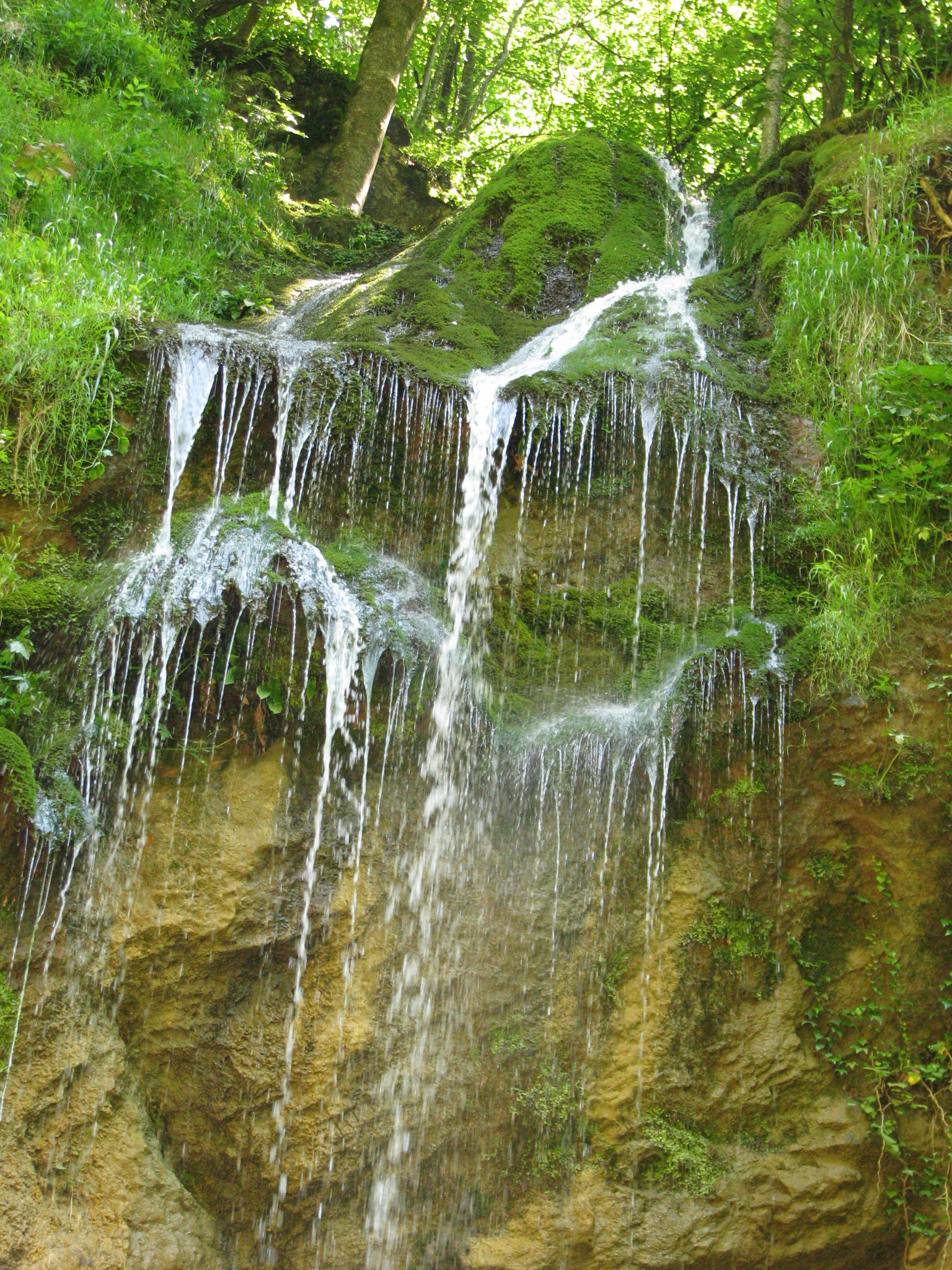
If Žumberak has its loveliest corner, many would say it is the valley of the Slapnica — a deep, shaded valley often called a canyon because of its steep sides, protected as a special landscape. Through it flows the little river of the same name which, typically for a karst region, disappears underground in places, dissolves dolomite rocks and creates tufa barriers and waterfalls.
The best known among them are the Vranjak waterfall, rich in tufa that still grows today through the natural process of deposition, and the Brisalo waterfall. Alongside them, the park hides other pearls too — the mighty Sopot waterfall near Sošice, over forty metres high and one of the tallest in Croatia, and the picturesque Cerinski vir in the Samobor Hills. A walk along these waterfalls, especially in spring or after rain when they are richest in water, is one of the loveliest experiences the park offers.
Water, springs and caves
Žumberak is a region exceptionally rich in water. In its area more than three hundred springs and several hundred streams and watercourses have been recorded — a rarity for a karst region, where water usually disappears quickly underground. It is precisely that abundant water that shaped the green valleys, waterfalls and lush forests that give it an almost alpine character.
Beneath the surface hides another world. The dolomite and limestone body of the mountain range is dotted with numerous caves and pits, among which the Grgos cave near Otruševec stands out, richly decorated with speleothems and arranged for visitors. These caves are also important bat habitats, and their cold, quiet interiors open an entirely different face of this otherwise gentle, green region.
A wealth of plants and life
Žumberak is one of the biologically richest areas of continental Croatia. In its area more than a thousand plant species have been recorded, many of them rare and protected — among them Daphne blagayana, numerous wild orchids, the mountain peony and the endemic Croatian iris. Alongside the varied flora, the park boasts a great wealth of fungi and lichens, indicators of a preserved, clean environment.
Forests cover most of the mountain range — from oak-hornbeam in the lower areas to beech on the highest ridges, some of which are protected as old forest reserves. In them live roe deer, wild boar, foxes and numerous other animals, while birds of prey circle the sky. For nature-watchers Žumberak is therefore an inexhaustible treasury, all the more valuable for being so close to a large city.
The Uskoks: five centuries of heritage
Žumberak is not only nature but also a unique human story. In the 16th century, fleeing the Ottoman conquests, the Uskoks settled here — warriors and their families whom the emperor invited to defend the frontier. Their descendants have lived here for almost five centuries, preserving a distinctive identity, customs and the Greek Catholic (Eastern Catholic) faith, by which Žumberak differs from the surrounding regions.
That heritage can be touched at every step — in the old Greek Catholic churches, in the ethnographic collections and museums devoted to Uskok life, and in the very villages where old costumes, language and tradition are preserved. That deep cultural dimension makes Žumberak a park in which nature cannot be separated from the people who shaped it for centuries.
Budinjak: princes from the Iron Age
Žumberak's past reaches far further back than the Uskoks. At the site of Budinjak one of the most significant archaeological sites in this part of Croatia was discovered — a large necropolis from the early Iron Age, with dozens of burial mounds (tumuli) in which ancient princes and warriors were buried, together with weapons and jewellery.
Today Budinjak is arranged as an archaeological park with an educational "Path of the Princes", which leads visitors through the mounds and explains the life of the people who lived here almost three thousand years ago. Along with an eco-centre that tells the story of the region's nature and history, Budinjak is proof that Žumberak was inhabited and prized as far back as prehistory — a place where history is read directly from the earth.
Old castles and mills
Ruins of medieval fortresses are scattered across Žumberak and the Samobor Hills too, among which Okić stands out — a fortress on a steep hill above Samobor, considered one of the oldest noble seats of north-western Croatia. Alongside it, the region hides other old castles and numerous little churches and chapels.
The mills also left a special trace. There were once more than one hundred and eighty of them along the Žumberak streams, driven by the region's abundant water. Today only a few are preserved — such as the mill at the Sopot waterfall — but they testify to times when the streams were the driving force of everyday life. These traces give the park the warmth of an inhabited, cultivated landscape, different from the wilderness of the high mountains.
Through the seasons
Žumberak is beautiful at any time. Spring wakes the forests and meadows and fills the waterfalls with water, and orchids and wild flowers cover the grasslands. Summer brings the pleasant shade of the deep valleys, a perfect escape from the city heat, with ideal conditions for hiking and cycling. Autumn colours the beech forests gold and copper and is the time of the harvest and traditional flavours. Winter can turn the region white with snow, transforming the mountains and villages into a quiet, fairy-tale picture.
The most inhabited mountain range in Croatia
One of Žumberak's peculiarities is that, despite its height and steepness, it has always been inhabited — and at surprisingly great altitudes. Its plateaus and slopes are among the highest permanently inhabited areas in Croatia, with dozens of small villages scattered across the ridges and valleys. In a hundred or more settlements only a few thousand people live today, mostly an older, rural population.
That sparse population has given the region a special atmosphere — quiet, slow, almost stopped in time. Abandoned houses and overgrown orchards testify to the great emigrations of past centuries, but also to the stubborn persistence of those who stayed. For the visitor this means a landscape of unusual calm, in which between forests and pastures a village with a stone church occasionally appears, like a picture from another time.
Why visit Žumberak of all places
In a world where Croatian tourism revolves almost exclusively around the sea, Žumberak offers something entirely different — and that is precisely its charm. Here there are no crowds or noise; there are forests, waterfalls, silence and authentic villages where old heritage is preserved. For those who love an active holiday, hiking, cycling and exploring, Žumberak is almost inexhaustible, and its nearness to Zagreb makes it perfect for day escapes into nature.
In addition, a visit to Žumberak is easily combined with discovering Samobor, its famous sweets and the wine roads of nearby Plešivica. Žumberak is thus not only a park but an entrance into a whole region rich in flavours, history and peace — proof that the greatest treasure sometimes lies right beside a large city, and yet entirely hidden from its bustle.
A practical guide to visiting
- Getting there. The park stretches west of Zagreb, beyond Samobor, up to the Slovenian border. It is most easily approached from Samobor or Jastrebarsko; marked roads lead to the main sites.
- Tickets and information. Entry to the park is mostly free; seek information, maps and guided tours at the Slani Dol and Budinjak eco-centres.
- Sights. Do not miss the Slapnica canyon with its waterfalls, the Sopot waterfall, the Grgos cave, the Budinjak archaeological park with the Path of the Princes and the ruins of Okić.
- Trails. The park offers more than 300 km of hiking and 200 km of cycling trails of all difficulties, as well as spots for sport climbing and paragliding launch sites.
- Footwear and gear. For the forest and mountain trails sturdy shoes are essential; bring water and, in the warmer months, tick protection.
- Rules. Move on marked trails, do not touch the tufa barriers or the speleothems in the caves and respect private property in the villages.
- Combine with the surroundings. Samobor with its famous cream cakes, the wine roads of Plešivica and the nearness of Zagreb make Žumberak a perfect weekend destination.
Conclusion
Žumberak with the Samobor Hills is proof that to escape into almost alpine nature you need not travel far — it is enough to go beyond Samobor. Here, within reach of the capital, hide canyons with waterfalls, caves full of speleothems, the mounds of ancient princes and villages where Uskok heritage has lived for five centuries. It is a park for those who love the blend of nature and story, silence and tradition — a green, mountain world in which, just half an hour from Zagreb, you feel you have stepped into another, calmer time.