Istrian maneštra: the thick soup that warms Istrian homes
In Istria they say that a day without maneštra is not a proper day. Maneštra is a thick, nourishing soup — somewhere between a soup and a stew — that has been cooked in Istrian homes for centuries, almost daily, and that is to Istrians what brudet is to Dalmatians or štrukli to the people of Zagorje: a dish of home, childhood and identity. Its smell — of beans, cured meat and vegetables simmering for hours — is the smell of Istrian cuisine in its purest form.
Although it shares roots with Italian minestrone, over the centuries Istrian maneštra became entirely its own: thicker, more generous and always enriched with cured pork — prosciutto bones, pancetta or dry ribs — which give it a depth an ordinary vegetable soup does not have. Its base is beans and potato, and alongside them, depending on the season, is added whatever the field gives: young corn, sauerkraut, fennel, broad beans or barley. In this recipe we present the best-known version — maneštra od bobići (with young corn) — along with an overview of the other variants.
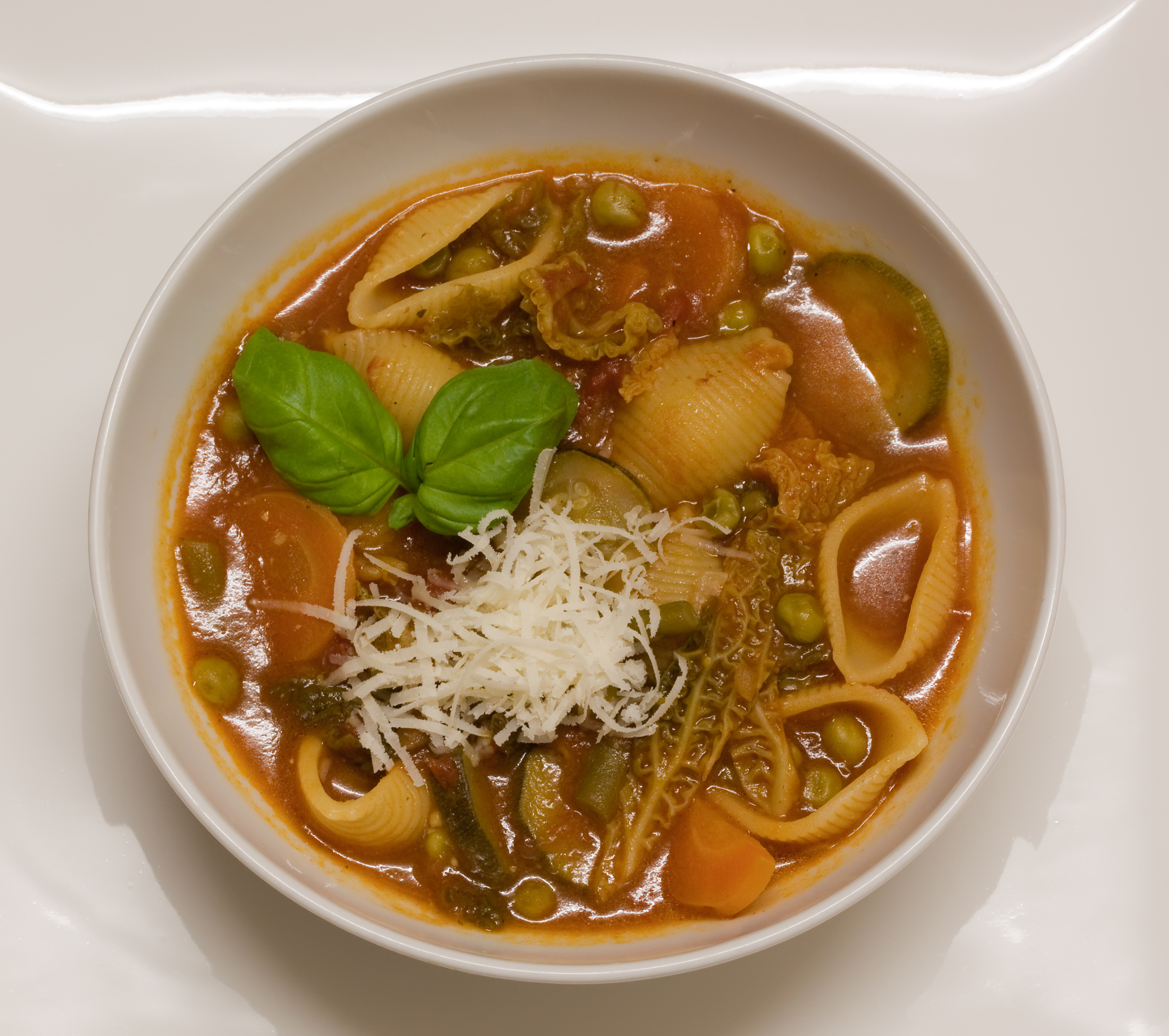
 A thick homemade maneštra. Photo: Wikimedia Commons (source file)
A dish of thrift and wisdom
Maneštra was born of scarcity — of a peasant kitchen in which nothing was thrown away, and a meal had to feed a whole family after hard work in the field. A prosciutto bone that elsewhere would end up in the bin became, in Istria, the golden base of a soup; a handful of beans, potato from one's own garden and seasonal vegetables turned into a dish that fills, warms and comforts.
It is precisely that wisdom — to draw the maximum from the most modest ingredients — that made maneštra a symbol of Istrian cuisine. Today it is proudly served even in the best Istrian taverns, often in earthenware bowls, as testimony that real cooking begins not at a delicatessen market but in a clever, patient kitchen.
A hundred houses, a hundred maneštras
In Istria no one will be able to tell you how many kinds of maneštra there are — because every house, village and season has its own. The most famous is maneštra od bobići, with young corn, cooked in summer when the corn is milky and sweet. In winter jota reigns — a maneštra with sauerkraut or turnip, also beloved in neighbouring Kvarner and Slovenia.
There is also maneštra of fennel (wild fennel), of broad beans, of barley (orzo), of chickpeas, and even meatless ones, cooked on Fridays and during Lent. They share a common base: beans, potato, cured meat and patient, long cooking. The recipe that follows you can easily adapt — swap the corn for sauerkraut and you have jota, add barley and you have orzo maneštra.
Ingredients
For 6 people:
- 300 g dried beans (brown or borlotti), soaked overnight
- 500 g cured pork: prosciutto bone, dry ribs, pancetta or a combination
- 3–4 ears of young corn (kernels cut off the cob) or 300 g sweetcorn
- 3 potatoes, peeled and cut into cubes
- 1 large onion, finely chopped
- 2 cloves of garlic
- 1 carrot and a piece of celery, grated
- 2 tablespoons tomato paste (or 2 ripe tomatoes)
- 1 bay leaf, parsley
- olive oil, salt, pepper
- pešt (traditional addition): 50 g pancetta finely worked with garlic and parsley into a smooth paste
Preparation
- Soak the beans. Soak the beans in cold water overnight; drain them before cooking.
- Start the base. Into a large pot put the beans, cured meat and bay leaf, pour in about 2.5 litres of cold water and set to cook. Cook over low heat, skimming off the foam.
- Sauté the vegetables. In a pan, in olive oil, sauté the onion, carrot and celery until they soften; add the garlic and tomato paste, sauté briefly and then transfer everything into the pot.
- Add the pešt. The traditional flavour secret: stir the finely worked paste of pancetta, garlic and parsley (pešt) into the soup — it is the "soul" of maneštra.
- Cook slowly. Simmer for 1–1.5 hours, until the beans and meat soften. Take out the meat, separate it from the bones, cut it up and return it to the pot.
- Corn and potato. Add the corn kernels and potato cubes and cook a further 30-odd minutes, until everything is soft and the soup thick.
- Thicken. For a thicker maneštra, mash some of the beans and potato against the side of the pot with a spoon. Salt and pepper to taste (careful: the cured meat is already salty).
- Rest. Take off the heat and let it rest for at least 15 minutes. Maneštra, like all pot dishes, is even better the next day.
Tips for perfect maneštra
- A prosciutto bone is maneštra's greatest treasure — if you have one, the soup will get a depth that nothing else gives.
- Do not skip the pešt: that little paste of pancetta, garlic and parsley separates a real Istrian maneštra from an ordinary soup.
- Thickness is a matter of pride — a real maneštra is so thick that "a spoon stands up in it"; mash some of the beans for creaminess.
- Salt at the end, because the cured meat releases its own; taste and then add salt.
- Cook a large quantity — maneštra the next day and the day after only gains in flavour.
What to serve with it
Maneštra is served hot, with good homemade or corn bread, and in Istria a drop of young olive oil often comes over each bowl, along with a glass of Istrian malvasia or, in winter, teran. It is a complete meal — after a good bowl of maneštra you need no main course, perhaps just a piece of cheese or fritule to finish.
It is best eaten the way it has always been eaten in Istria: slowly, from a deep bowl, with conversation at the family table, while outside the bura blows or the rain falls — because maneštra is not just food, but warmth in liquid form.
The most common mistakes
The most common mistake is rushing the beans: insufficiently soaked or too-fiercely cooked beans will stay hard or fall apart into their skins. Soak them overnight and cook over low heat. The second trap is over-salted soup — the cured meat releases a lot of salt, so salt only at the end, after tasting. The third is a thin, watery maneštra: if the spoon "does not stand up", mash some of the beans and potato or cook uncovered a little longer.
And lastly — do not leave out the cured meat or the pešt thinking it makes no difference. Without them you will get a decent vegetable soup, but not a maneštra; it is precisely the smoke, the fat and the garlic that make that difference by which Istrian cuisine is recognised from the first spoonful.
Conclusion
Istrian maneštra is proof that the greatest dishes often arise from the most modest ingredients. Beans, potato, a prosciutto bone and a little patience — and the result is a bowl that warms body and soul, a dish that fed Istria for centuries and that is today served with equal pride in village houses and top taverns. Cook it on a cold day, let it rest and serve it with good bread and a glass of malvasia. One spoonful will be enough to understand why Istrians say: a day without maneštra is not a proper day.