Walnut and poppyseed roll: the holiday queens of rolled dough
If in continental Croatia there is a smell that unambiguously means "holiday", it is the smell of yeast dough and baked walnuts spreading from the oven. Orehnjača (walnut roll) and her sister makovnjača (poppyseed roll) — soft, spiral rolls with a rich filling of ground walnuts or poppyseed respectively — stand on every Christmas, Easter and wedding table from Zagorje to Slavonia. There is hardly a Croatian who has not eaten them; harder still to find one to whom they do not smell of childhood.
These rolls are part of the great Central European family of cakes made from rolled yeast dough — relatives of the Slovenian potica, the Hungarian bejgli and the Polish makowiec — but in Croatian kitchens they long ago became their own, with their own ratios, tricks and family recipes jealously guarded. In this recipe we present both fillings on one dough, because a real holiday baking tray is anyway unimaginable without both loaves — one walnut and one poppyseed.
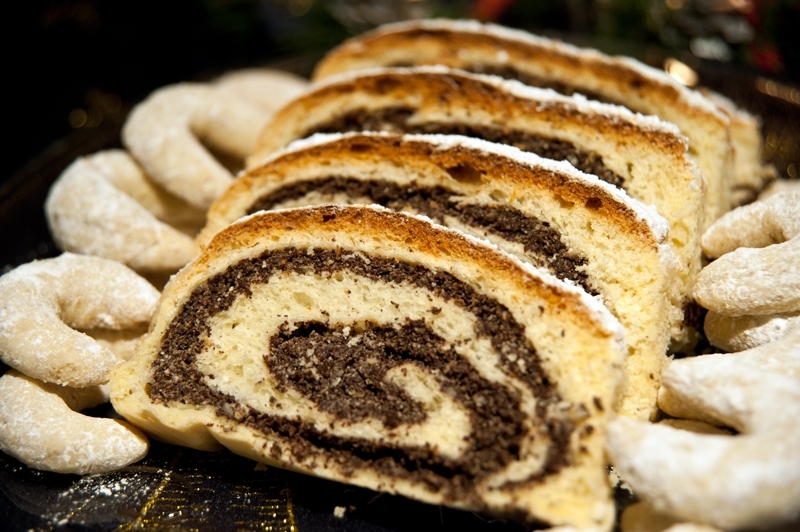
 Makovnjača, the sister of orehnjača. Photo: Wikimedia Commons (source file)
A cake that unites Central Europe
Rolls with walnuts and poppyseed travelled Central Europe for centuries, spreading across the space of the former Habsburg Monarchy together with wheat, mills and monastery bakeries. Each country named them in its own way and adapted them to itself — and in Croatia they settled in as orehnjača (in the north "orehnjača", from the Kajkavian oreh, elsewhere "orahnjača") and makovnjača, with an interesting local peculiarity: in some regions a variant with carob is made too.
Their holiday role is no accident: walnuts, poppyseed, butter and eggs were once costly, so such rich cakes were baked only for the greatest days. Hence the unwritten rule that they are baked in pairs and in quantity — because a holiday table without at least two loaves, and without a reserve for guests who "just drop by", does not exist in a Croatian home.
The secret is in the ratio and patience
Two things separate a superb orehnjača from a dry one. The first is the ratio of filling to dough: a stingily filled roll is the greatest disappointment of the holiday — there must be a generous amount of filling, almost as much as dough, so that the spiral in cross-section is thick and dark. The second is patience with the rising: the dough rises twice, in a warm place free of draughts, and is never rushed — rushed dough cracks and is dry.
The third, often forgotten trick: the filling must be soft and spreadable, cooked with milk and sugar, because a dry filling "drinks" the moisture from the dough. And the fourth: the baked loaf rests covered with a cloth, so the crust softens. With these four rules, success is guaranteed even the first time.
Ingredients
Dough (for 2 loaves):
- 600 g plain flour
- 30 g fresh yeast (or 1.5 sachets dry)
- 2.5 dl warm milk + 0.5 dl for the starter
- 100 g sugar + a teaspoon for the starter
- 100 g butter, melted
- 1 egg + 1 egg yolk
- grated lemon zest, a pinch of salt, a tablespoon of rum
Walnut filling (1 loaf):
- 300 g ground walnuts
- 1.5 dl milk, 100 g sugar, vanilla sugar
- a handful of raisins soaked in rum, a little lemon zest, a teaspoon of cinnamon (optional)
Poppyseed filling (1 loaf):
- 250 g ground poppyseed
- 2 dl milk, 100 g sugar, vanilla sugar
- a tablespoon of honey, lemon zest, a handful of raisins (optional)
For glazing: 1 egg yolk with a little milk
Preparation
- Starter. Crumble the yeast into half a decilitre of warm milk with a teaspoon of sugar and flour; leave 10–15 minutes to froth up.
- Make the dough. To the sifted flour add the starter, warm milk, sugar, melted butter, egg and yolk, salt, lemon zest and rum. Knead until the dough is smooth, soft and elastic and comes away from the bowl.
- First rising. Cover the dough with a cloth and leave it in a warm place for 45–60 minutes, until it doubles in volume.
- Fillings. Bring the milk with the sugar to the boil, pour it over the walnuts (or poppyseed), stir in the remaining ingredients and let it cool — the mixtures must be spreadable, neither dry nor runny.
- Roll out and fill. Divide the risen dough into two parts. Roll each into a rectangle half a centimetre thick, spread evenly with filling (leaving a 2 cm border clean) and roll up tightly along the longer side.
- Second rising. Place the loaves seam-side down in a greased baking tray (spaced apart or separated with a piece of paper/butter so they do not stick together), glaze with egg yolk and leave a further 20–30 minutes.
- Baking. Bake at 180 °C for 50–60 minutes, until they get a deep golden colour; if they darken too fast, cover them with foil.
- Rest. Cover the baked loaves with a clean cloth and let them cool completely before cutting — only then does the spiral stay whole and the cake juicy.
Tips for a perfect roll
- Fill generously: the cross-section must be a thick spiral; stinginess is visible on an orehnjača from a mile off.
- Roll tightly, but do not squeeze — too loose gives gaps, too tight cracks the loaf.
- Everything at room temperature: cold eggs and milk slow the yeast.
- No draughts while rising; yeast loves quiet and warmth.
- Cut cooled, with a sharp serrated knife — a warm loaf gets squashed and crumbles.
What to serve with them
Orehnjača and makovnjača are served cut into finger-thick slices, dusted with icing sugar, with coffee, tea or mulled wine — and children, by old custom, love best to dip them in hot milk or cocoa. On the holiday table they stand alongside fritule, kroštule and dried fruit, and a shot of prošek or walnut liqueur accompanies them excellently.
Well wrapped, the loaves stay juicy for days — if anyone manages to keep them that long. In most houses the walnut one goes first; in others the poppyseed. That is a debate older than all the recipes.
The most common mistakes
The most common mistake is a dry, stingy filling — the walnuts and poppyseed must be cooked with milk into a spreadable mixture, and there must be plenty of it. The second is a rushed rising: dough that has not doubled in volume gives a dense, heavy roll. The third is a cracked loaf — the result of too-tight rolling or too-hot an oven; roll firmly but gently and bake at a moderate temperature.
Watch the cutting too: a warm loaf looks irresistible, but the knife squashes it — patience until it cools is part of the recipe. And finally, do not buy ground walnuts that are who-knows-how-old; rancid walnuts ruin even the best dough. Freshly ground — freshly baked, that is the golden rule of holiday baking.
Conclusion
Orehnjača and makovnjača are more than cakes — they are the fragrant calendar of Croatian holidays, the cake generations grew up with and the measure of every "proper" homemaker. Their preparation takes an afternoon and a little patience with the yeast, but the reward is a baking tray from which, the moment the cloth is lifted, the house turns into a holiday. Make the dough, fill generously, let the dough do its thing — and cut only once it has cooled. And then watch the spirals vanish, slice by slice, with coffee, conversation and that old question without an answer: walnut or poppyseed?