Lamb under the peka: a rite of fire, embers and patience
Some dishes are not just food but a rite — and none more so than lamb under the peka. Here you do not cook on a stove but on an open hearth; you do not measure in minutes but in embers and experience; and you do not eat in a hurry but in company, after hours of waiting by the fire, wine and conversation. The peka is the way in which Dalmatia, the Hinterland and Lika have celebrated for centuries — family, guests, holidays and everything worth gathering for.
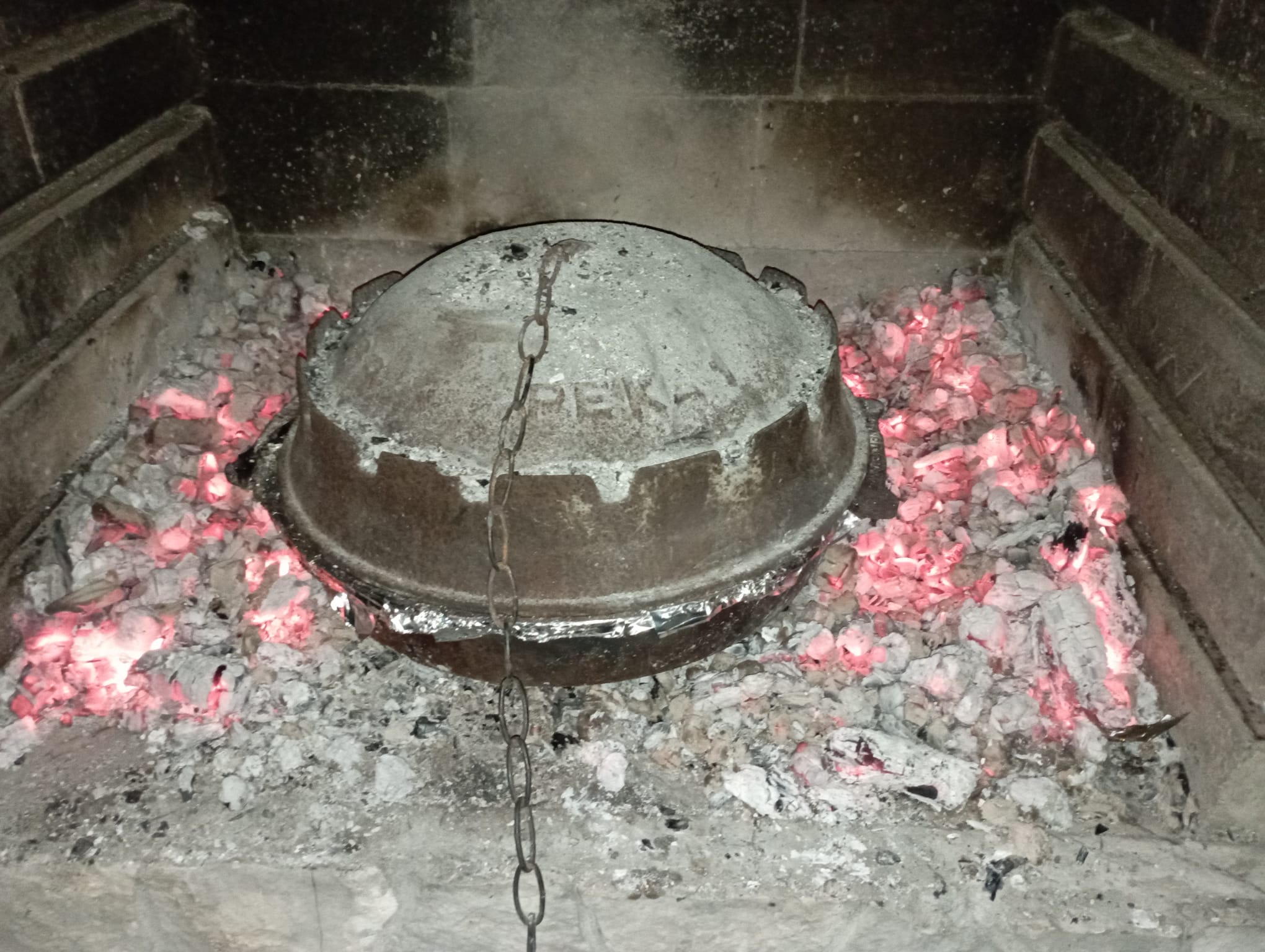
The peka itself (in Istria called čripnja) is an iron or once clay bell with which the dish is covered on the hearth, and then buried in embers and ash. Under that bell the meat and potato roast slowly, in their own juices and fat, without touching the flame — and it is precisely this that gives the lamb that famous tenderness, juiciness and aroma of smoke that no oven can reproduce. In this article we present both the story and the method, along with an adaptation for those who do not have a peka.
 A peka on the hearth, buried in embers. Photo: Wikimedia Commons (source file)
A thousand-year-old technique
Roasting under a bell is one of the oldest food-preparation techniques in this region — archaeologists find its traces back in prehistory, and clay bells were used on hearths for centuries before iron ones. In regions poor in wood and water, the peka was a perfect solution: one hearth, one vessel, minimal supervision and a result that surpasses any oven.
That technique was passed down from generation to generation and has remained almost unchanged to this day. In many Dalmatian and Lika homes the hearth with a peka is still the centre of gatherings, and the "peka masters" — usually fathers and grandfathers — guard their knowledge of fire, embers and time as a family treasure. The peka is, alongside the grill, the most prized way of preparing food in the south of Croatia.
Why lamb is the queen of the peka
All sorts of things go under the peka — veal, chicken, octopus, even bread — but lamb is its undisputed queen. Dalmatian and Lika lambs, raised on the meagre, aromatic pastures full of sage and heather, give a meat of a distinctive, full flavour that develops to perfection under the peka.
The secret is in the method of roasting: under the bell, at a temperature that slowly falls, the meat both roasts and braises in its own juices at the same time. The fat melts and bastes the potato, the skin turns golden, and the meat becomes so tender it falls off the bone. Add to that the gentle note of smoke from the hearth — and you have a flavour remembered for a lifetime.
Ingredients
For 6–8 people:
- 2.5–3 kg lamb (shoulder and leg, cut into larger pieces)
- 1.5 kg potatoes, peeled (halve the larger tubers)
- 2–3 onions, cut into quarters
- 1 head of garlic, cloves peeled and whole
- 2–3 sprigs of rosemary and a few sage leaves
- 1.5 dl olive oil
- 2 dl white wine
- coarse salt, pepper
- optional: paprika, a few slices of bacon for aroma
Equipment: a peka (iron bell) with its accompanying shallow pan or dish, a hearth with good hardwood (hornbeam, beech, olive) and a poker. Alternative without a peka: a large cast-iron pot with a lid and an oven.
Preparation on the hearth
- Prepare the fire. Light a hardwood fire at least an hour before roasting — you need plenty of quality embers, and the hearth stone (komin) must be well heated.
- Season the meat. Rub the pieces of lamb with coarse salt, pepper and olive oil. Let them rest while the fire burns down.
- Assemble the dish. In a shallow vessel (the tegla) arrange the potato, onion and garlic, salt them, pour over the oil, then spread the pieces of lamb over it all with the rosemary and sage. Douse everything once more with a little oil.
- Cover and bury. Rake the embers aside, set the vessel on the hot komin, cover with the peka and bury the bell in embers and ash — most along the edges and on top.
- First roasting. Roast for about 60–75 minutes without lifting the peka. Keep the fire going to the side so you always have fresh embers.
- Turning and basting. Lift the peka, turn the pieces of meat, baste them with the wine and the juices from the vessel, stir the potato. Cover again and bury with fresh embers.
- Second roasting. Roast another 60–90 minutes, depending on the quantity and the embers. Near the end you can remove some of the embers from the top so the skin does not darken too much — or add more if you want a crispier crust.
- Check and rest. The meat is done when it separates easily from the bone and the potato is golden and soaked with juices. Let the dish rest for about ten minutes before serving — best straight from the vessel, to the middle of the table.
Version without a peka (in the oven)
No hearth? A heavy cast-iron pot with a lid gives the closest result. Assemble the ingredients the same way, cover and roast in an oven heated to 200 °C for about an hour, then uncover, turn the meat, baste with wine and roast a further 45–60 minutes at 180 °C, the last 15 minutes uncovered so it browns. The note of smoke will be missing, but the tenderness and juiciness will be very close to the original.
Tips from the peka master
- The embers are everything. Use hardwood and prepare more than you think you need; weak embers mean a pale, soggy dish.
- Do not peek. Every lifting of the peka lets out heat and prolongs the roasting; the peka is lifted only once, for turning.
- Potato below, meat above — that way the fat and juices from the meat soak into the potato, which many consider the best part of the dish.
- Let the salt be coarse and do not skimp; lamb loves generous salting.
- Allow plenty of time. The peka tolerates no rush — better that the guests wait for the peka than the peka for the guests.
What to serve with it
Lamb under the peka is served straight from the vessel, with a green salad or tomato salad, homemade bread and — obligatorily — good red wine: plavac, babić or teran. Before the peka one traditionally nibbles prosciutto and cheese with a shot of brandy, and after it comes something light, like fruit or pancakes.
But the real "side dish" of the peka is the time spent by the hearth: the hours in which you wait, talk, top up the wine and tend the fire. The peka is slow food in the most beautiful sense — a dish that brings people together even before it reaches the table.
The most common mistakes
The first and greatest mistake is impatience — lifting the peka every half hour "to see how it's going". Every opening lets out heat, dries the meat and prolongs the roasting; the peka is opened once, for turning, and that is all. The second mistake is poor or insufficient embers: softwood burns quickly and does not hold heat, so the dish stays pale and half-roasted. Always prepare more embers than you think you need and keep an auxiliary fire going to the side.
The third trap is an overloaded vessel — if the meat and potato stand in too many layers, the lower ones braise in liquid instead of roasting. It is better to use a wider vessel or roast in two batches. And finally, do not forget that lamb loves salt: too-weakly-seasoned meat under the peka is the most common complaint of beginners. Coarse salt, good fat and fragrant herbs — that is the holy trinity of every good peka.
Conclusion
Lamb under the peka is more than a recipe — it is a rite that brings together fire, patience and people. You cannot order it "for right now"; it must be earned by waiting, and it is precisely that waiting that turns a meal into an event. If you have the chance to roast on a real hearth, do not miss it; if you do not, the oven version too will bring a breath of Dalmatia to your table. In both cases, when you lift the lid and the smell of lamb, rosemary and smoke fills the room, you will understand why they say of the peka that it is the most festive way in which Dalmatia says: welcome.