Kopački Rit Nature Park: Europe's Amazon at the confluence of the Drava and the Danube
In the far east of Croatia, where the river Drava flows into the mighty Danube, spreads a world of water, reeds and forest of a kind that has almost vanished in Europe. This is Kopački Rit — a vast floodplain wetland in Baranja, one of the best-preserved river wetland areas on the whole continent. When the rivers swell, the water spreads across the landscape, turning it into a labyrinth of channels, lakes and flooded forests; when it recedes, lush meadows and life-filled mud remain. Because of that exceptional lushness and wildness, Kopački Rit is often called "Europe's Amazon".
Protected as a nature park, Kopački Rit is above all a paradise for birds and the aquatic world. Nearly three hundred bird species have been recorded here, and the rivers and marshes are one of the largest fish spawning grounds of the entire Danube basin. Because of this value the park is included on the most important international lists of wetland habitats and bird areas. For the visitor, it is a place completely different from stony, maritime Croatia — a quiet, flat, watery kingdom in which nature still breathes to its ancient rhythm.
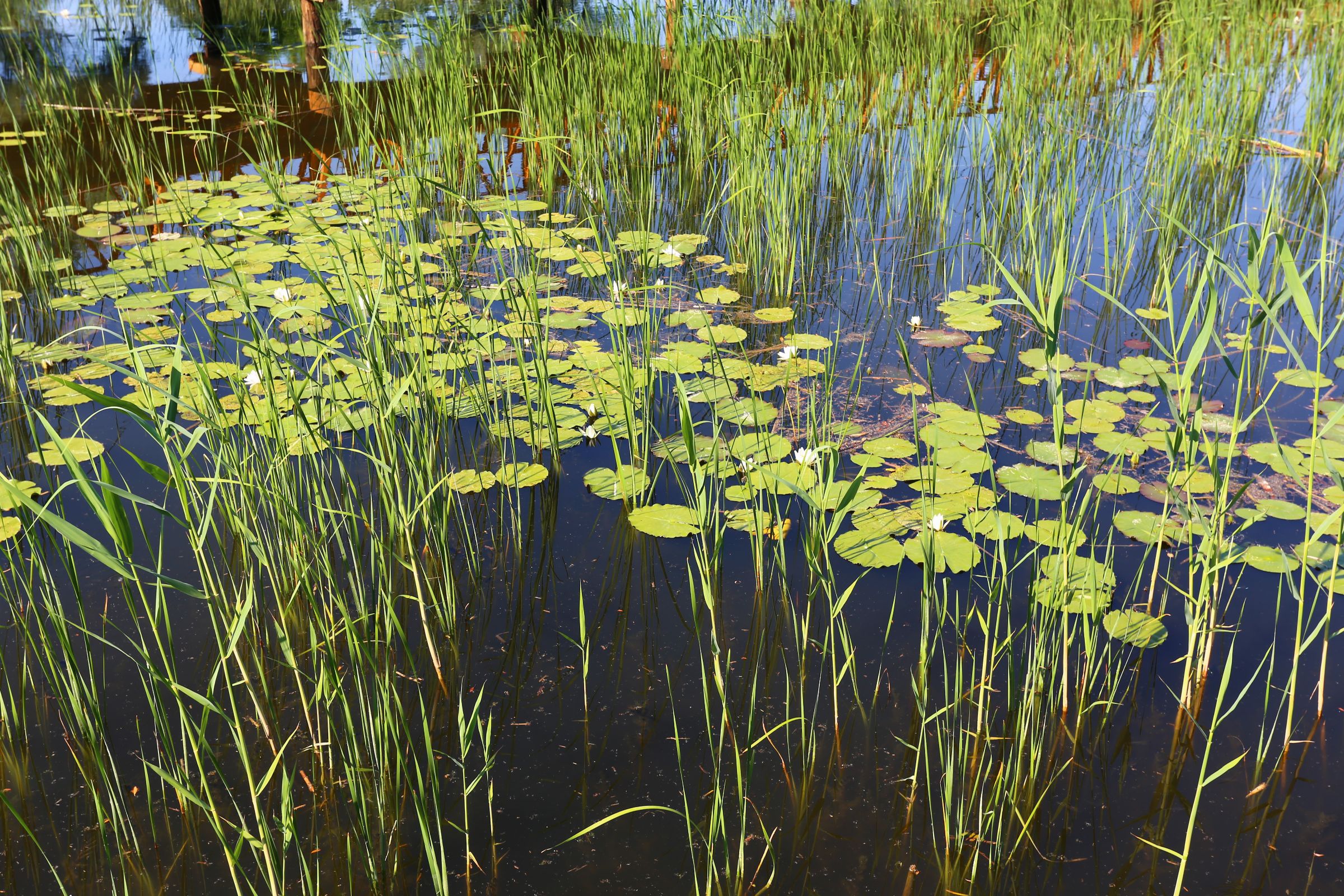
 Water lilies and reed beds of Kopački Rit. Photo: Wikimedia Commons, licence CC BY-SA 4.0
A landscape created by the rivers
Kopački Rit is a landscape that did not come into being once and for all — it is created and changes every year, depending on the rivers. When the Danube and the Drava swell, usually in spring and early summer, the water floods the whole area, turning it into a vast lake dotted with forests and islands. When the water level falls, meadows, muddy banks and a network of channels are revealed.
That rhythm of flooding and drying is the heart of the whole ecosystem. It brings nutrients, renews habitats and creates the conditions for an incredible wealth of life. Unlike landscapes that man has "tamed", Kopački Rit still lives by the rules of the river — one of the few places in Europe where the natural process of flooding takes place almost undisturbed.
A paradise for birds
If Kopački Rit is known for anything, it is for its birds. Nearly three hundred species have been recorded here, of which a great number regularly nest, while others stop on their migration routes. The sky and waters of the park are home to herons, spoonbills, white-tailed eagles, storks, cormorants, wild geese and ducks and countless other species, including those that are rare or endangered elsewhere in Europe.
It is precisely because of this value that Kopački Rit has for decades been among Europe's most important bird areas, and its southern part has been declared a special zoological reserve, with the strictest protection. For birdwatchers the park is a true place of pilgrimage — one of the best in this part of the continent, where in a single day, with a little luck and patience, dozens of species can be seen.
A spawning ground of the Danube
Kopački Rit is rich not only above the water but also below it. Its warm, shallow, nutrient-rich waters are one of the largest fish spawning grounds of the entire Danube basin. During the flooding, countless fish come here to spawn, and the fry grow up in the sheltered labyrinth of channels and lakes before returning to the great rivers.
This makes Kopački Rit vital not only for the park itself but for the whole river system — a kind of cradle of life of the Danube waters. Carp, pike, catfish and numerous other species find ideal conditions here, and the abundance of fish feeds the birds and other animals too, closing the circle of this exceptionally productive ecosystem.
Willow and poplar forests
Kopački Rit is not only water and reeds — a large part of the park is also covered by floodplain forests, above all dense stands of white willow, but also poplar and other trees adapted to periodic flooding. These forests, submerged in water when the rivers swell, give the landscape that almost tropical, "Amazonian" look for which the park is known.
Alongside the forests stretch endless reed beds and marsh and grassland areas, each with its own plant and animal world. That diversity of habitats — from open water through reeds to forest — is the reason Kopački Rit can feed so many different species. Every corner of the park is home to someone, and the mosaic of those habitats makes it one of the biologically richest areas in Croatia.
Deer, boar and wilderness
Although birds are the stars of Kopački Rit, the park is also home to larger animals. Numerous herds of deer and wild boar move through its forests and meadows, present here in large numbers, along with roe deer, foxes, martens and other animals. In the mating season, the autumn call of the deer echoes through the marsh as one of the most striking sounds of the wilderness.
Alongside them, the park teems with amphibians, reptiles and invertebrates — from frogs and turtles to countless insects that are the foundation of the whole food pyramid. That full, densely populated wilderness gives Kopački Rit the feeling of a place where nature still rules — a rare corner of Europe where man is a guest, not a master.
Tikveš: a castle in the heart of the marsh
In the midst of that wilderness hides a trace of human history too — Tikveš castle, a former hunting residence. Through history the powerful came here, drawn by the abundance of game — from the Habsburg nobility to the Yugoslav leader Josip Broz Tito, who used Tikveš as his hunting ground and retreat.
Today that complex testifies to the dual nature of Kopački Rit — as a place of wilderness, but also as a landscape that for centuries drew people with its wealth. For the visitor Tikveš is an interesting addition to the natural experience, a blend of history and nature in the heart of one of Europe's largest marshes.
How to experience the park
Kopački Rit is best experienced from the water. Organised boat rides take visitors through the channels and lakes, opening a view of the birds, forests and aquatic world from the best perspective. Alongside the boat rides, the park also offers a network of educational trails, wooden bridges and observation towers, as well as cycling routes through the Baranja landscape.
Unlike some parks that are toured in a few hours, Kopački Rit demands slowness and patience. Its beauty is not imposed but revealed gradually — in a silence broken by the flight of a heron, in the glint of the sun on the water, in the call of a deer in the distance. It is a park for those who love to observe, to listen and to immerse themselves in the rhythm of nature.
Through the seasons
Kopački Rit changes its face with every season, and the rivers set the rhythm. Spring brings the flooding, the awakening of life and the peak of bird nesting — many consider it the loveliest time. Summer is lush and green, ideal for boat rides, but also warm and full of mosquitoes. Autumn brings bird migrations, the deer rut and golden colours — the second great highlight for visitors. Winter is quiet and cold, often foggy, when the marsh calms and the wintering birds remain.
Part of the "Amazon of Europe"
Kopački Rit is not an isolated island of wilderness — it is part of a much larger, cross-border wetland system that stretches along the Mura, Drava and Danube through several countries. That vast belt of river habitats, one of the last of its kind in Europe, is increasingly called the "Amazon of Europe" and has been included in the international network of biosphere reserves, raising its protection to a continental level.
That connectedness gives Kopački Rit added weight. It is not merely a beautiful marsh landscape but a key link in one of Europe's most valuable ecological corridors — a place through which birds, fish and other life travel, connecting distant areas into a single living whole. To preserve Kopački Rit therefore means to preserve part of the heart of all European wilderness.
A few curiosities to close
Kopački Rit abounds in facts that surprise. It is one of the best-preserved river wetland areas in all of Europe, with nearly three hundred recorded bird species. Its waters are one of the largest fish spawning grounds of the entire Danube basin. Because of its value it was included on the international list of important wetlands back in 1993, and among Europe's important bird areas even earlier, in 1986. And in the midst of that wilderness hides Tikveš castle, a former hunting ground where both the Habsburg nobility and the Yugoslav leader stayed.
All this makes Kopački Rit a park that overturns the image of Croatia as a purely maritime and stony country — proof that in its east hides a watery kingdom of world value, quiet and lush, full of birds, fish and life.
A practical guide to visiting
- Getting there. The park lies in Baranja, north-east of Osijek, beside the villages of Kopačevo and Bilje; it is easily reached by road from Osijek.
- Tickets and rides. An entrance ticket and organised boat rides are charged; book boat tours and guided visits in advance, especially in season.
- Birdwatching. Bring binoculars; the best time for birds is spring and autumn, and the early morning hours give the most sightings.
- Gear. Sun protection and, especially in summer, mosquito protection are essential; footwear should be comfortable and moisture-resistant.
- Rules. Move on marked trails and follow instructions; the zoological reserve in the southern part has the strictest protection and a special visiting regime.
- Combine with the surroundings. The Baranja villages, wine roads and famous gastronomy (fiš-paprikaš!) and the city of Osijek with its fortress make Kopački Rit a perfect part of a Slavonia-Baranja journey.
Conclusion
Kopački Rit is an entirely different face of Croatia from the one most people know — there is no sea or stone, there is water, reeds and endless sky over which flocks of birds circle. It is one of the last great, living river wetland areas of Europe, a place where the rivers still freely shape the landscape and wilderness rules. Whether you glide by boat through the channels, watch herons from a bridge or listen to the deer rut at dusk, Kopački Rit immerses you in a rhythm of nature long lost elsewhere — a true European Amazon in the east of Croatia.