Kornati National Park: a galaxy of stone in the middle of the Adriatic
It is said that when the writer George Bernard Shaw caught sight of the Kornati, he remarked that God, wishing to crown His work, created these islands on the last day of creation out of tears, stars and breath. Whether that is truth or a lovely legend, it is hard to invent a better description. The Kornati is a place where it seems someone scattered a handful of stones across the sea — nearly ninety islands, islets, reefs and rocks crammed into a small space, bare, silvery and seemingly lifeless, yet in fact full of a quiet, sharp beauty.
Declared a national park in 1980, Kornati National Park protects the most indented and densest island archipelago in the entire Mediterranean. There are no waterfalls or lush forests here; here the leading actors are stone, sea, light and wind. And it is precisely that austerity, that almost lunar emptiness, that makes the Kornati one of the most unusual landscapes in Croatia.
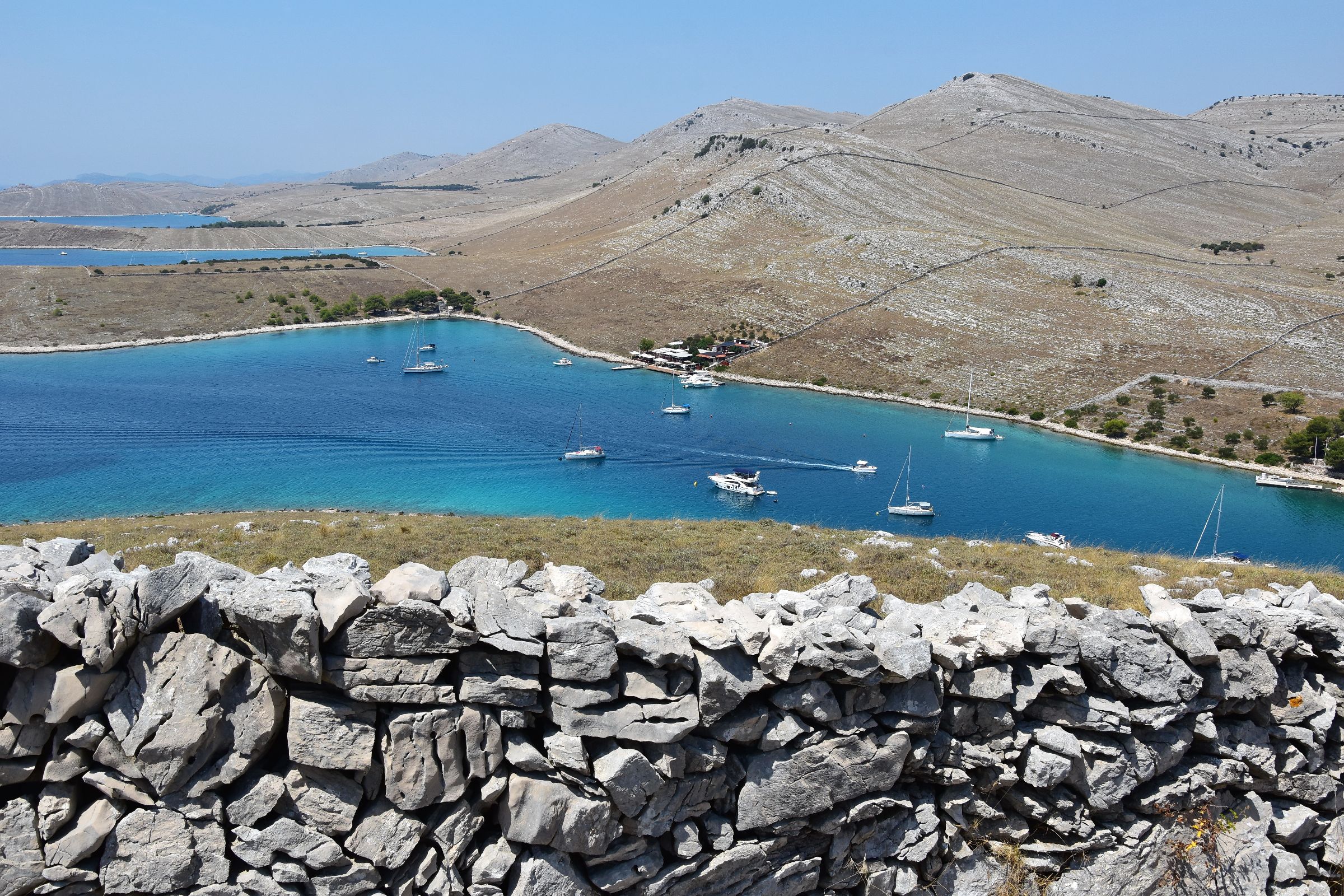
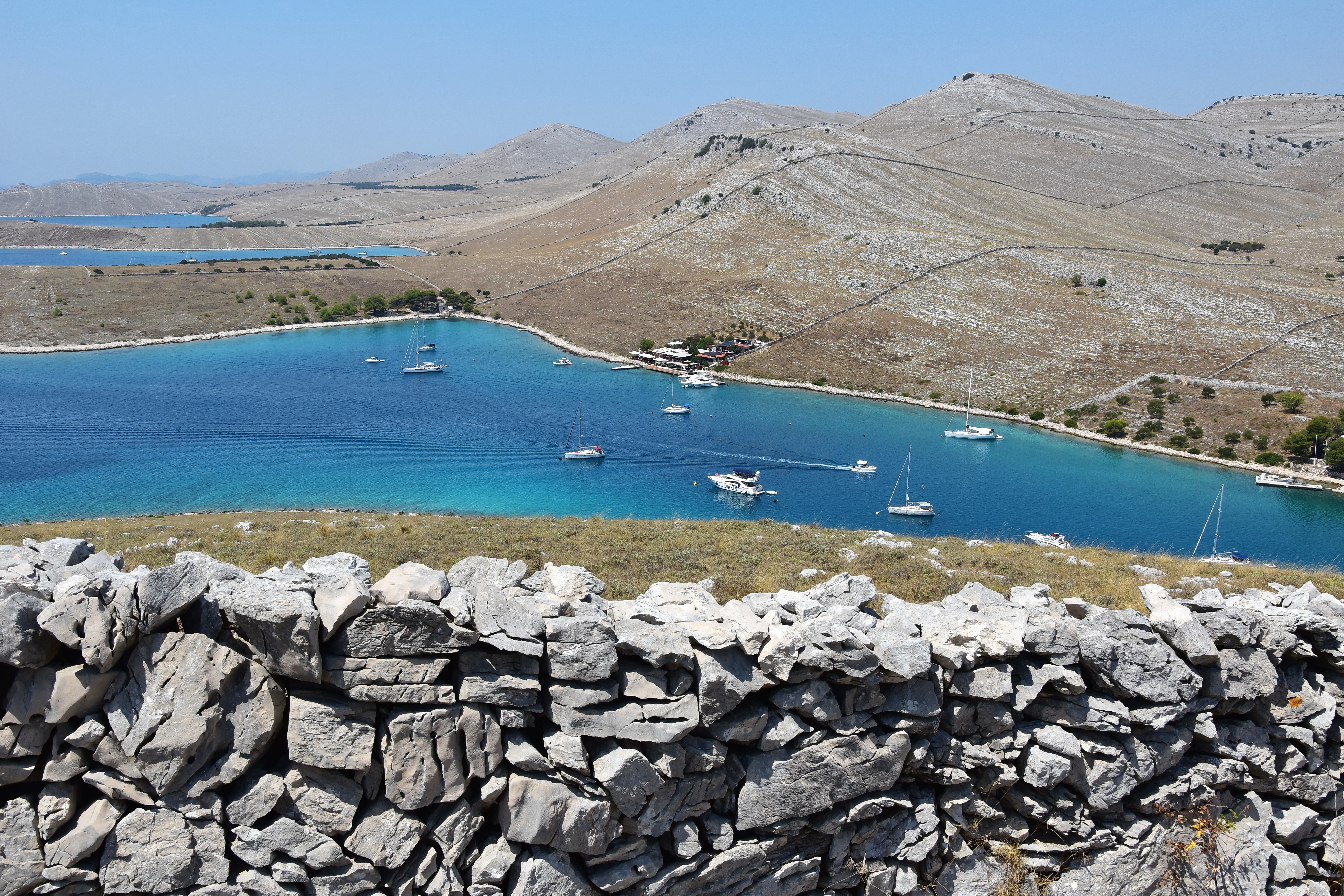 The bare, silvery landscape of the island of Kornat. Photo: Wikimedia Commons, licence CC BY-SA 4.0
The "crowns": cliffs facing the open sea
If you know the Kornati only from a map, you might think they are a string of featureless stone islands. But their secret is hidden on the seaward side, where few see them from the mainland. Toward the open sea the islands break off abruptly into vertical cliffs that the locals call "crowns" (in dialect also krški). These are sheer rock faces that rise as much as eighty metres out of the sea, as if someone had sliced off half the island with a giant knife and thrown it into the depths.
The most magnificent of all the crowns is the one on the island of Mana, whose vertical rocks plunge straight into the open sea and against which the waves of the bura wind break. It is precisely these cliffs, exposed to wind and storms, that give the Kornati their dramatic, almost menacing character — completely different from the gentle, sheltered face the islands turn toward the inner, protected sea.
How they came to be: geology without mercy
Geologically speaking, the Kornati are the peaks of a submerged mountain range. They were once part of the mainland, but when the sea rose after the last ice age, the valleys were flooded and only the ridges remained — today's islands. That is why they are arranged in regular, parallel rows, like a rumpled blanket over which the sea has been poured.
The bedrock is almost exclusively limestone, washed by rain and salted by the sea, poor in soil. Because of this there are almost no trees on the islands — only low, tough vegetation, sage, immortelle and dry grass that yellows in summer. This seemingly barren nakedness is in fact the result of both nature and man: centuries of sheep grazing and the felling of what little vegetation there was made the Kornati what we know them as today — stony, stripped bare, reduced to their essence.
Life above and below the sea
At first glance the Kornati look like a desert. But that is an illusion that holds only for the surface. Above the sea life is scarce but adapted: gulls and slender terns nest on the rocks, falcons hunt along the cliffs, and lizards bask on the scorching stone. Drystone walls and solitary olive trees testify that people once cleared and planted here too.
Below the sea, however, an entirely different world opens up. The Kornati seabed is one of the richest in the Adriatic — steep underwater rocks, coralligenous formations, shoals of fish, octopuses, lobsters and colourful sponges. That is precisely why a large part of the park is marine, and diving is allowed only with a permit and in the company of authorised centres, so as to preserve that fragile balance. For many visitors the real Kornati begin only when they dive in.
People, drystone walls and the shepherd's life
Although there are no permanent inhabitants on the Kornati today, the islands are not empty of history. Most of the land is owned by people from the nearby island of Murter, who for centuries used the Kornati as pasture for sheep, for growing olives and vines, and as a fishing ground. Their presence is inscribed in the landscape in the form of kilometres of drystone walls — stone fences built without a scrap of mortar, dividing plots and winding across the bare slopes like seams on stone.
Beside the walls stand modest stone cottages, once shelters for shepherds and fishermen, and today many converted into simple taverns that in summer offer local fish, lamb and wine to guests from the boats. On the island of Kornat are also the remains of the fortress of Tureta (Toreta), a Byzantine watchtower from the 6th century, and the little church of Our Lady of Tarac, a place of traditional gatherings and processions. These rare testimonies show that even this seemingly inhospitable land was always part of the human story.
A paradise for sailors
You do not visit the Kornati by chance — you have to reach them by sea, and that is exactly what makes them a shrine for sailors from all over the world. The labyrinth of nearly ninety islands offers countless hidden coves, anchorages and passages, and the sheltered inner sea is ideal for sailing. The park also has marinas and moorings in the coves, and many taverns offer their boat guests a free berth in exchange for dinner.
For those without their own vessel, organised full-day excursions depart for the Kornati from Murter, Zadar, Šibenik, Biograd and other coastal towns. Such a trip usually includes a cruise through the most beautiful parts of the archipelago, a stop at Mana's crown, a swim in one of the coves and lunch in a Kornati tavern — the easiest way to experience this world of stone in a single day.
Through the seasons
Unlike the mainland parks, the Kornati are above all a summer, maritime destination — but even here there are nuances. Spring is perhaps the loveliest of all: after the rains the sparse vegetation briefly turns green and blooms, the sea is clear and there are no crowds yet. Summer is the height of the season, with a warm sea perfect for swimming and diving, but also the most boats and the strongest sun — shade is a rarity on the Kornati, so a hat and water are essential. Autumn brings back peace and pleasant temperatures, with the sea still warm. Winter leaves the Kornati to the bura and to solitude; the park is then quiet, almost inaccessible, open mostly to those who come by their own vessel and know the sea well.
The island of Kornat and the name of the archipelago
The name of the whole archipelago comes from the largest island — Kornat, which stretches nearly thirty kilometres in length and by itself makes up more than half the land area of the park. Linguists derive the name from the Latin word coronata, "crowned", which fits neatly with both the dialect name for the cliffs ("crowns") and with Shaw's image of God crowning His work.
Kornat is not only the largest but also the richest in history. At its south-western end, in Tarac bay, Illyrian, Roman and early Christian traces have alternated across millennia. Here the Romans exploited the shallows to obtain salt, and above the bay the remains of the 6th-century Byzantine fortress of Tureta, which guarded the sea route, still stand today. Beside it is the little church of Our Lady of Tarac, a place that once a year gathers the people of Murter for a traditional celebration — a rare moment when this quiet world of stone comes alive with voices, prayer and the scent of roast lamb.
Bread from stone: how people lived on the Kornati
To understand the Kornati, you have to understand the effort it took to survive on them. The people of Murter came here for centuries by boat, ferrying sheep, tools, seedlings and water — for there is no source of drinking water on the islands. Rainwater was collected in cisterns, olive groves were shielded from the wind and animals by drystone walls, and every scrap of arable land was wrested from the karst with hand-stacked stones.
That culture of drystone walls is today protected as a cultural asset and an integral part of the park's identity. Kilometre after kilometre of stone barriers, raised without a single drop of mortar, testify to generations that drew life out of the bare stone. When today you sail past an island and see those regular lines climbing the slopes, you are in fact looking at a map of human toil — every wall means someone's years of labour.
The shepherd's life still smoulders on: sheep graze freely across the islands, and their lamb, roasted in the Kornati taverns, is considered a delicacy precisely because of the aromatic herbs they feed on.
Protecting a fragile balance
The Kornati are beautiful precisely because they have remained almost untouched — but that balance is delicate. The bare soil erodes easily, the seabed reacts to the slightest pollution, and birds nest on rocks where the least disturbance drives them away. That is why the park has strict rules: certain places are designated for anchoring, diving is possible only under supervision, and picking plants or taking anything from the sea or the land is not allowed.
For the visitor, this actually works in their favour. The rules that protect the Kornati also protect the very reason people come — that rare feeling that you have arrived in a place man has not yet managed to spoil.
A few curiosities to close
The Kornati abound in details that surprise even experienced seafarers. Although in everyday speech people say "the Kornati", the national park covers only part of the archipelago — around 89 islands, islets and rocks — while the whole Kornati archipelago consists of even more scattered points of land. In such a small space there is an exceptionally dense concentration of islands, which is why many consider the Kornati the most indented archipelago in the entire Mediterranean.
It is also interesting that the park has not a single permanent inhabitant, and yet it is full of human traces — from drystone walls and olive groves to taverns and little churches. Mana's cliffs, today one of the park's emblems, in the past also served as a film backdrop, and their vertical drama has inspired countless photographers and painters. And finally, the name "Kornati" and the adjective "crowned" have merged so completely with this landscape that it is hard to say where geography ends and poetry begins.
All this makes the Kornati a destination that resists quick sightseeing: this is a place for slow sailing, a long swim in a hidden cove and an evening over fish and wine, as the sun sets behind the stone ridges.
A practical guide to visiting
- Getting there. The park is reached exclusively by sea. The simplest way is to take an organised full-day excursion from Murter (the nearest departure port), Zadar, Biograd, Šibenik or Vodice. Experienced sailors come by their own or a chartered vessel.
- Tickets. An entrance ticket is charged for staying in the park, and it is cheaper to buy it in advance (organised trips usually include it in the price). For vessels the price is set according to length and is valid for the day of the stay.
- Anchoring and mooring. Anchoring and mooring are allowed only in designated places and in coves under concession; many taverns offer a berth with dinner. Respect the marked areas to protect the seabed.
- Diving. Allowed only with a permit and organised by authorised diving centres. Unregulated diving is not permitted.
- Bring everything with you. There are no shops or sources of drinking water on the islands. Water, sun protection, a hat and sturdy footwear for walking over the sharp karst are essential.
- Leave no trace. Picking plants, disturbing birds and leaving litter are strictly forbidden. The Kornati are fragile — what you bring in, take out.
- The finest sights. Do not miss Mana's crown from the seaward side, Lojena cove on Levrnaka (one of the few sandy beaches) and the panorama of the archipelago from the higher viewpoints on Kornat.
Conclusion
The Kornati are not easy to love at first sight — no waterfalls, no forests, no lavish greenery. But if you approach them with the right eyes, you will discover beauty reduced to its purest form: stone, sea and light, without anything superfluous. It is a landscape that does not shout but whispers, and that rewards the patient traveller with the feeling of having reached the end of the world — or, if Shaw is to be believed, a place where creation is crowned with tears, stars and breath.