Krka National Park: the river that builds cathedrals of water
There are rivers that merely flow, and there are those that build. The Krka belongs to this second, rarer kind. On its way through the Dalmatian karst, from the foot of Dinara to the sea near Šibenik, this river has not merely carved a canyon but has, drop by drop, built an entire series of waterfalls, tufa barriers and emerald lakes. The result is one of the most beautiful water landscapes in Europe and, together with Plitvice, the most visited Croatian national park.
Declared in 1985 as the seventh Croatian national park, Krka National Park stretches across some 109 square kilometres along the middle and lower course of the river. But figures barely convey what awaits the visitor at the entrance: the roar of water, the mist of billions of tiny droplets hovering in the air, and the greenery that breaks through every crack in the stone.
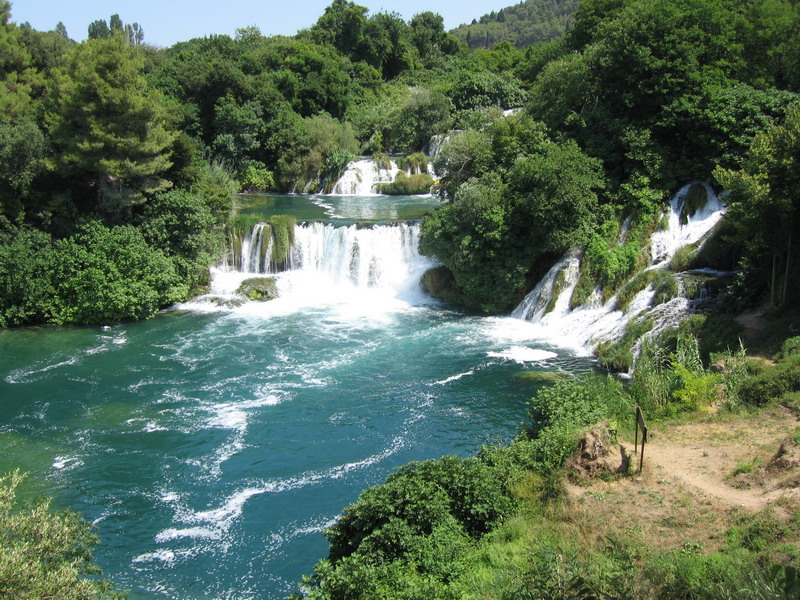
 Skradinski buk, the largest tufa cascade in Europe. Photo: Wikimedia Commons, licence CC BY-SA 3.0
Skradinski buk: the crown of the park
If you know the Krka from a single photograph, it is almost certainly Skradinski buk. This waterfall is not one cascade but a whole system — seventeen cascades strung along a stretch of about eight hundred metres, with a total drop of roughly forty-six metres. That makes it the largest tufa waterfall in Europe, a place where an enormous volume of water spills over steps of living stone and gathers in a broad, clear pool at the bottom.
Skradinski buk is the lowest of the great waterfalls on the Krka and also the most accessible. A network of wooden paths and little bridges leads through it, guiding the visitor above, alongside and almost through the cascades, accompanied all the while by the roar and the coolness. In the summer months the flow diminishes, but in winter as much as three times more water pours through the river, and the waterfall then takes on all its force.
As on Plitvice, the secret of the Krka's waterfalls lies in tufa (travertine). This porous limestone deposit forms when mosses, algae and bacteria in water rich in calcium carbonate cause crystals to settle around them. The tufa barriers thus grow, hold back the water and create new steps and lakes. The landscape is not static — it changes, millimetre by millimetre, to this day.
Roški slap, Visovac and hidden waterfalls
The Krka is much more than a single waterfall. Upstream lie six more great falls, each with its own character.
Roški slap is the second most visited. Its upper part is made up of a series of shallow, wide cascades that the locals call the "Necklaces" — the water spreads over them like a string of pearly aprons before plunging into the greenish Visovac lake. Around the falls are restored old watermills and ethnographic collections, and nearby is the prehistoric Oziđana cave.
Between Skradinski buk and Roški slap, in the middle of the river, lies the islet of Visovac — one of the most idyllic sights in Croatia. On it, Franciscans built the monastery of Our Lady of Mercy back in 1445, and the white church surrounded by cypresses and blue-green water looks as if it has risen out of a fairy tale. Visovac is reached by boat, which is often included in the tour.
Further upstream hide waterfalls seen by fewer visitors: Manojlovac, the highest in the park, surrounded by forest and canyon; Bilušića buk, the only waterfall never used to generate electricity; and the hard-to-reach Rošnjak, which the locals call "The Altar". Anyone with time and their own transport finds here a Krka without crowds.
Watermills and the world's first hydroelectric plant
For centuries the water of the Krka did not only delight but also worked. Beside the waterfalls sprang up watermills and fulling mills for cloth — on Skradinski buk and Roški slap there were many, and today's buildings mostly date from the end of the 19th century. Today some of them have been restored and turned into small museums where visitors can see how grain was once milled and cloth was woven.
The greatest story, however, is tied to electricity. At the foot of Skradinski buk in 1895 the hydroelectric plant Jaruga began operating — only two days after the famous plant at Niagara. It was the first hydroelectric plant in Croatia and one of the first in the world for the production of alternating current, which lit up nearby Šibenik and made it one of the first cities in the world with public alternating-current lighting. The river that built waterfalls proved to be a builder of modern Dalmatia as well.
Life around the river
Because of its position on the boundary between the Mediterranean and continental climates, the Krka is exceptionally rich in life. Around 860 plant species have been recorded, among them endemics of the Illyrian-Adriatic region, and the surrounding slopes hold one of the highest densities of wild lavender in Europe — so in summer the air smells of blossom, and bees and wasps hum.
The river is an ornithological jewel as well: an important migration corridor passes through the park, more than 220 bird species have been recorded, and ospreys, short-toed eagles, golden eagles and falcons circle the skies. In the water live eighteen fish species, of which as many as ten are endemic — a fact that places the Krka among natural rarities of the highest order. Otters hide along the river, and bats inhabit the caves.
People, fortresses and monasteries
The Krka is not only nature. Along the canyon stand the remains of medieval fortresses — Ključica, Nečven, Trošenj, Bogočin — which guarded the crossings and testify to a turbulent past. Nearby is the Roman Burnum, with the remains of a military camp and amphitheatre, the only one of its kind on the Croatian karst.
Alongside Catholic Visovac, the park also hides the Orthodox Krka Monastery, set upstream in the silence of the canyon. The proximity of these two shrines, Catholic and Orthodox, in such a small space tells the story of this land's complexity as eloquently as the waterfalls themselves.
Swimming: what is allowed today
For years the emblem of the Krka was swimming below Skradinski buk — the sight of tourists swimming in front of the waterfall travelled the world. To protect the sensitive tufa and the purity of the river, swimming at Skradinski buk itself is no longer allowed today. That does not mean you cannot swim in the park: the administration has designated other locations along the river where swimming is possible, so check the current rules and marked spots on entry.
Tufa: how a river becomes a builder
It is worth pausing for a moment on why the Krka looks the way it does, because this is no accident but a slow, patient chemical process thousands of years old. The water that springs up beneath Dinara passes through limestone karst and in doing so dissolves large quantities of calcium carbonate. When such mineral-saturated water reaches the rapids and spills over an obstacle, part of the carbon dioxide is released into the air, and the dissolved limestone begins to settle — especially on the mosses, algae and tiny bacteria that live in the current.
These plants and microorganisms thus become the mould for new stone. Layer by layer, the barrier grows, the water is held back behind it and forms a small lake, and the overflow across the rim shapes a new waterfall. What the visitor sees as a "waterfall" is in fact a living, growing structure — and that is exactly why it is so sensitive. Touching, treading or pollution can halt the growth of tufa that takes centuries. When the park insists that you stay on the wooden paths, it is not bureaucracy but the protection of something that is literally alive.
This same phenomenon links the Krka with Plitvice: both rivers are "tufa-forming", both build barriers and cascades. The difference is in the atmosphere — Plitvice is mountainous, cold and forested, while the Krka is Mediterranean, sun-drenched, surrounded by cypresses, immortelle and wild lavender.
Through the four seasons
The Krka changes its face with the seasons just as dramatically as with the flow of water.
Spring is the peak of its power: after the winter rains and snowmelt the river swells, and the waterfalls thunder at full force. Nature is fresh green, and the crowds are still moderate. Summer brings heat, cicadas and the scent of Mediterranean herbs, but also the lowest water levels — some smaller waterfalls weaken then — and the biggest crowds, so an early arrival is essential. Autumn restores the water and colours the riverside vegetation in warm tones, with pleasant temperatures ideal for walking. Winter reveals a Krka few ever see: almost empty paths, mist over the canyon and waterfalls at full strength, when many times more water flows through the river than in summer.
For photographers and those escaping the crowds, it is precisely the shoulder seasons — late spring and early autumn — that are the best choice.
Flavours and tradition of the region
A visit to the Krka is not complete without a taste of what the region is known for. In Skradin, the small town at the river's mouth from which boats set off toward the waterfalls, is born the Skradin risotto — a thick, dark dish that, by tradition, is cooked for hours and watched over by the men, who stir it for as long as eight hours until the rice soaks up the rich meat stock. Alongside it goes the Skradin cake, a confection of almonds and walnuts whose recipe local families have guarded for generations.
In the park itself, beside the restored watermills, you can sample local products — prosciutto, cheese, honey and brandies — and see what daily life along the river looked like before tourism changed this region. That bond of nature and tradition gives the Krka a warmth that bare statistics about waterfalls cannot convey: this is not merely a protected natural phenomenon, but a landscape in which people lived for centuries, milling grain and fulling cloth with the power of the very same water that delights visitors today.
A few curiosities to close
The Krka hides facts that surprise even regular visitors. The Jaruga plant made Šibenik one of the first cities in the world with public street lighting on alternating current — in the company of only a handful of the world's metropolises of the time. The tufa system of Skradinski buk is the largest of its kind in Europe, and on its way to the sea the river creates seven great waterfalls, of which Manojlovac is the highest and Skradinski buk the largest and most visited. The canyon is home to one of the densest populations of wild lavender on the continent, so in summer the whole valley smells of blossom. And the islet of Visovac, with its Franciscan monastery, has been continuously inhabited for almost six centuries — a little oasis of silence in the midst of a river that never rests.
All this makes the Krka a park that rewards both those who come for just a few hours and those who devote a whole day to exploring its distant waterfalls, fortresses and mills.
A practical guide to visiting
- Entrances and getting there. The park has several entrances; the best known are Skradin (from where a boat runs to Skradinski buk) and Lozovac (the closest to Split, with a car park and a panoramic bus to the falls). Roški slap and Burnum have their own, quieter entrances. From Split, Lozovac is about an hour's drive; from Šibenik just twenty minutes.
- Tickets. It is wise to buy tickets online in advance, especially in summer. The price varies by season — highest in July and August, and considerably lower off-season. The boat ride to Skradinski buk is often included in the price.
- When to come. Spring and autumn (April–June, September–October) bring the most water and the fewest crowds. In summer the waterfalls are weaker and the paths full, so come early in the morning.
- Footwear and paths. The wooden bridges can be wet and slippery; sturdy, non-slip shoes are essential. The main loop trail around Skradinski buk is under two kilometres and easy to walk.
- Boat excursions. From Skradinski buk boats depart for Visovac and Roški slap; the ride to Roški slap takes about 40 minutes and is the loveliest way to see the canyon from within.
- Rules. Follow the marked paths, do not touch the tufa, carry your litter out with you. Drones and swimming outside the permitted zones are not allowed.
- Combine with the surroundings. Šibenik with the Cathedral of St James (UNESCO), Skradin with its small marina and famous Skradin risotto, and the fortresses above the town make a perfect full-day trip.
Conclusion
The Krka is most easily experienced as a spectacle — and a spectacle it is. But if you pause on a little bridge above Skradinski buk and let the roar and the water-mist envelop you, you realise you are looking at something rarer than a mere waterfall: a river at work, a builder that for centuries has patiently laid down a cathedral of water and stone. It is a Dalmatian wonder that does not stand still — and that is exactly why it is worth returning to.