Paklenica National Park: the canyons of Velebit between sea and sky
There are parks whose beauty is looked at, and there are those whose beauty is earned. Paklenica is without doubt the latter. Here, on the southern slopes of Velebit near Zadar, the mountain plunges steeply toward the Adriatic, and through it two torrential streams have carved two magnificent canyons over the millennia. The result is a landscape in which, over just a few kilometres, you pass from the sea's edge to peaks higher than one thousand seven hundred metres — from Mediterranean heat to mountain freshness.
Declared a national park back in 1949, Paklenica is the second-oldest Croatian national park, right after Plitvice. But while Plitvice celebrates water, Paklenica celebrates stone and height. For hikers, climbers and everyone who loves wild, vertical nature, this is one of the most exciting destinations in this part of Europe — a place where in the morning you can swim in the sea and in the afternoon climb a rock face over two hundred metres high.
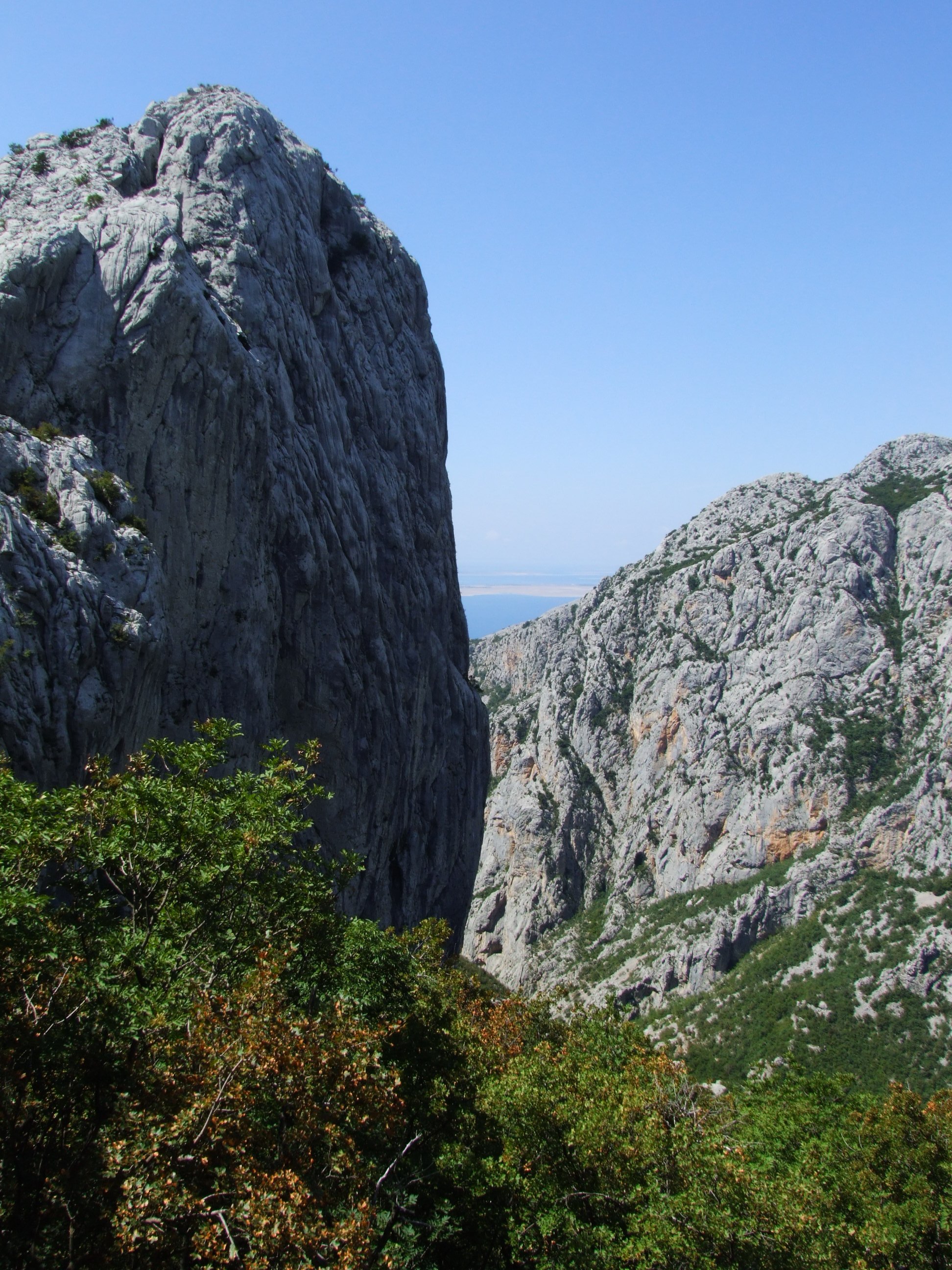
 Anića kuk, the most famous climbing rock in Croatia. Photo: Wikimedia Commons (source file)
Two canyons: Velika and Mala Paklenica
The heart of the park is formed by two canyons, the only breaks in the otherwise unbroken, steep wall of Velebit facing the sea. Velika Paklenica (Great Paklenica) is the larger, more accessible and more visited — about fourteen kilometres long, and at its narrowest just some fifty metres wide, with vertical cliffs rising on both sides more than seven hundred metres. The main, shaded trail runs through it along the stream, leading the visitor through the most spectacular part of the park.
Mala Paklenica (Small Paklenica) is smaller, wilder and far less visited. Its stream is weaker and dries up in summer, and the canyon at its narrowest is just some ten metres wide. It is precisely because of that solitude that Mala Paklenica becomes a refuge of the wild — it is planned as a zone of peace for the nesting of griffon vultures. For those seeking solitude and challenge, it is the most authentic part of the park.
Anića kuk and a climbing paradise
Above the mouth of Velika Paklenica rises Anića kuk — a huge, almost vertical rock over seven hundred metres high, with a climbing face more than two hundred metres tall. It is the most famous climbing rock in Croatia and one of the most respected climbing destinations in Europe. On the rocks of Paklenica more than five hundred climbing routes of all grades have been set up — from beginner routes to those that challenge the world's top climbers.
The climbing tradition here reaches back decades. As early as the mid-20th century local alpinists scaled Anića kuk with gear that would look unthinkably modest today — ropes and hand-forged pitons. Today Paklenica draws climbers from all over the world every spring, and its climbing school and prepared routes make it as accessible to beginners as to masters. Even for those who do not climb, the sight of tiny climbers on the enormous rock is breathtaking.
 The vertical cliffs of the Velika Paklenica canyon. Photo: Wikimedia Commons (source file)
Manita peć: an underground castle
Paklenica reveals itself not only toward the sky but also toward the depths. In the upper part of the Velika Paklenica canyon hides Manita peć, the only cave in the park adapted for visitors. Though modest from the outside, within it reveals spacious halls decorated with speleothems — stalactites and stalagmites shaped by water over thousands of years.
A steep path branching off the main trail leads to the cave, so a visit is possible at arranged times with a guide. For those who decide on the climb, the reward is twofold: a view of the canyon from a height and immersion in the quiet, cold underground world that stands in sharp contrast to the scorching stones outside.
Up to the peaks of Velebit
Although it is best known for its canyon, Paklenica is in fact a park of great heights. Above the cliffs stretch dense beech and black-pine forests, and higher still mountain meadows and bare peaks. The highest among them is Vaganski vrh (1,757 m), also the highest peak of the whole of Velebit. More than one hundred and fifty kilometres of hiking trails run through the park, from an easy stroll to demanding multi-day tours.
The most popular is the ascent from the entrance to the mountain lodge in the heart of the park, which takes about two hours and is suitable even for the less experienced. From there the trails lead higher, toward peaks offering a view of the entire central Adriatic, its islands and the endless ridge of Velebit. That vertical diversity — from the sea to 1,757 metres — makes Paklenica one of the richest habitats in the Dinarides.
Beech old-growth forests under UNESCO protection
Among the park's most valuable treasures are its old beech forests. In 2017 parts of these primeval old-growth forests in Paklenica, together with those in neighbouring Sjeverni Velebit and in a number of other European countries, were inscribed on the UNESCO World Heritage List as part of the protected "Ancient and Primeval Beech Forests of the Carpathians and Other Regions of Europe".
These are forests untouched by man for centuries, in which trees grow, age and decay by their own laws, forming an ecosystem of inestimable value to science. To walk through such a forest is to see what Europe looked like before man reshaped it — a rare privilege in today's world.
Bunkers: a secret from the Cold War
At the very entrance to the Velika Paklenica canyon hides an unexpected trace of human history — a complex of underground tunnels known as the Bunkers. They were dug in strict secrecy in the 1950s, during the tense period of Yugoslavia's conflict with the Soviet Union, as a shelter for the leadership of the time.
Today these tunnels, carved into the foot of a four-hundred-metre-high cliff, have been turned into a visitor centre with a multimedia hall and exhibition space. That combination of natural grandeur and Cold War history gives Paklenica an added, almost cinematic layer — a reminder that even these quiet canyons were part of great historical dramas.
Life in the canyon and on the peaks
Thanks to the enormous difference in altitude, Paklenica is home to exceptionally diverse life. More than a thousand plant species have been recorded, many of them endemic. On the cliffs nest birds of prey — the griffon vulture, the golden eagle and falcons — and in the depths of the forests live, though visitors rarely see them, three great European beasts: the bear, the wolf and the lynx.
Alongside them, chamois, roe deer, red deer and wild boar move through the park. This rich fauna is the result of both wilderness and the diversity of habitats — from the warm, sunny cliffs beneath which Mediterranean herbs grow, to the cold mountain peaks where snow lingers deep into spring.
Where the name "Paklenica" comes from
The park's name does not come from pakao ("hell"), as one might think, but from paklina — the resin of the black pine that used to be collected in these forests. This thick, sticky resin was used by the locals to coat and caulk their wooden boats, protecting them from the sea. And so the very name of the park is inscribed in that bond of man, mountain and sea that marks all of Paklenica.
Through the seasons
The best time to visit Paklenica is spring and autumn. Spring (April–June) brings full streams, blooming meadows and ideal conditions for climbing and hiking. Autumn (September–October) offers pleasant temperatures and the golden colours of the beech forests. Summer is hot, especially in the canyon, so an early start and plenty of water are essential — but the nearness of the sea allows a refreshing swim after the climb. Winter brings cold, snow on the higher parts and the dangerous bura — a strong, cold northern wind that can close the trails; the park is then accessible only to the most experienced.
From sea to snow in a single day
What makes Paklenica special is not only its height but the vertical diversity that few parks in the world offer in such a small space. If you set off from the entrance by the sea and climb to the highest peaks, in a single day you pass through several completely different worlds: the warm Mediterranean coast with olives and immortelle, the shaded canyon along the stream, the dense beech and black-pine forests, and finally the bare mountain meadows and peaks where snow lingers deep into spring.
That difference in altitude — from sea level to 1,757 metres — creates a true mosaic of climatic and vegetation zones. So in Paklenica, along a single stretch, you meet plants and animals that otherwise live hundreds of kilometres apart. For nature lovers it is as if the Mediterranean and the Alps were condensed into one place.
Ethno-heritage and life beneath the mountain
Although it is today primarily a natural refuge, Paklenica also preserves traces of the people who lived beneath the mountain for centuries. Within the park stands the Marasović ethno-house, a protected cultural asset whose traditional stone construction testifies to the craft of stonemasonry and to the hard but dignified life of the Velebit highlanders. In the summer season it is open to visitors as testimony to a former way of life.
These stone dwellings, drystone walls and old paths recall that Velebit was not only wilderness but also home — a mountain that people cleared, on which they grazed livestock and from whose pines they collected resin. It is precisely that blend of wild nature and quiet human traces that gives Paklenica a soul beyond its impressive cliffs.
A few curiosities to close
Paklenica hides facts that surprise even experienced hikers. On its rocks more than five hundred climbing routes have been set up, which is why it is one of the most important climbing destinations in Europe, and Anića kuk, with a climbing face more than two hundred metres high, draws climbers from all over the world. Vaganski vrh (1,757 m), located on the edge of the park, is also the highest peak of the whole of Velebit. The name "Paklenica" comes not from hell but from paklina — the pine resin once used to caulk wooden boats. And the bunkers at the entrance to the canyon, today a visitor centre, testify to a Cold War drama hidden in the midst of untouched nature.
All this makes Paklenica a park in which, in a single day, sea and mountain, adrenaline and peace, ancient wilderness and 20th-century history can all come together.
A practical guide to visiting
- Getting there. The park lies beside the town of Starigrad-Paklenica, along the Adriatic highway, about an hour's drive from Zadar and two hours from Split. The entrance to Velika Paklenica and the reception are located not far from the sea.
- Tickets and information. Tickets are bought at the reception at the entrance; there you can obtain trail maps and advice on routes suited to your fitness. For climbing and a visit to the Manita peć cave, ask about conditions and time slots.
- Water. The only reliable source of drinking water is at the reception, so be sure to bring an adequate supply for the whole day.
- Footwear and gear. Sturdy hiking boots are essential; for higher tours bring layered clothing, as the weather on Velebit changes quickly.
- Climbing. Paklenica offers over five hundred routes of all grades; beginners can seek out local climbing schools and guides in Starigrad. The climbing season lasts roughly from April to November.
- Rules. Move only on marked trails, do not take shortcuts (risk of rockfall) and follow the weather forecast because of the bura.
- Combine with the surroundings. The nearness of the sea, Zadar with its famous Sea Organ and Greeting to the Sun, and the neighbouring Sjeverni Velebit National Park make Paklenica a perfect starting point for a wider Velebit tour.
Conclusion
Paklenica is a park of contrasts — sea and mountain, heat and freshness, the silence of the canyon and the roar of the bura. It is a place where nature is not offered on a plate but demands effort, and in return gives a feeling that flat landscapes never can: the feeling of height, of space and of your own smallness before the vertical wall of Velebit. Whether you come to climb, to hike or just to walk the canyon to the first shade, Paklenica leaves a mark — and almost always an invitation to return and climb a little higher.