Kroštule: the crispy bows of Adriatic holidays
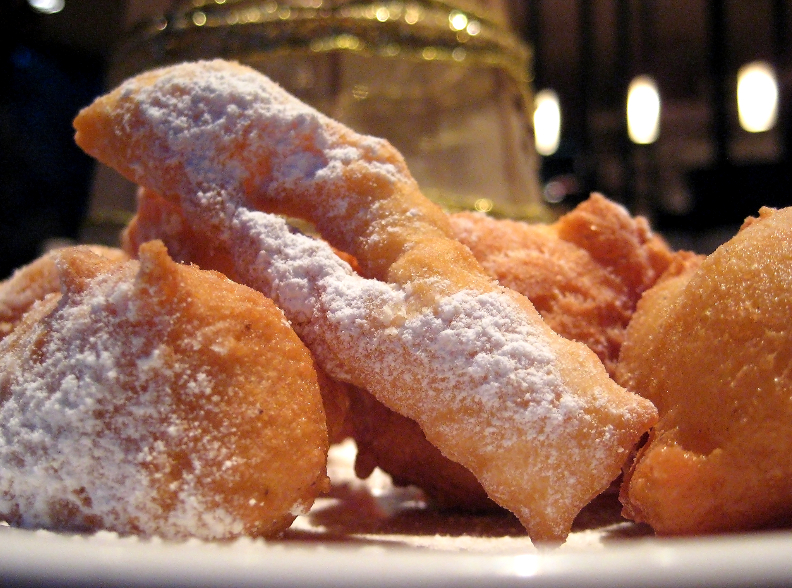
Where there are fritule, there are also kroštule — their crispy, elegant partner without which no holiday platter on the Adriatic is complete. While fritule are soft and round, kroštule are thin, crumbly and twisted into recognisable bows: strips of dough with brandy and lemon, pulled through themselves, fried to gold and buried in icing sugar. They are brittle, light and dangerously suited to "just one more" — a platter of kroštule, on average, lives shorter than a platter of any other cake.
Kroštule are fried from Istria and Kvarner to the southernmost Dalmatia, for Christmas, Carnival, weddings and festivities, and each region has its own name and small differences — somewhere they are hroštule, somewhere kroštuli. They share a dough that is rolled thin, a glass of brandy or wine in the mix, and that characteristic sound: the crunch by which, they say, a real kroštula can be recognised even with your eyes closed. In this recipe we present the classic Dalmatian kroštule, with tricks for bubbles and crumbliness.
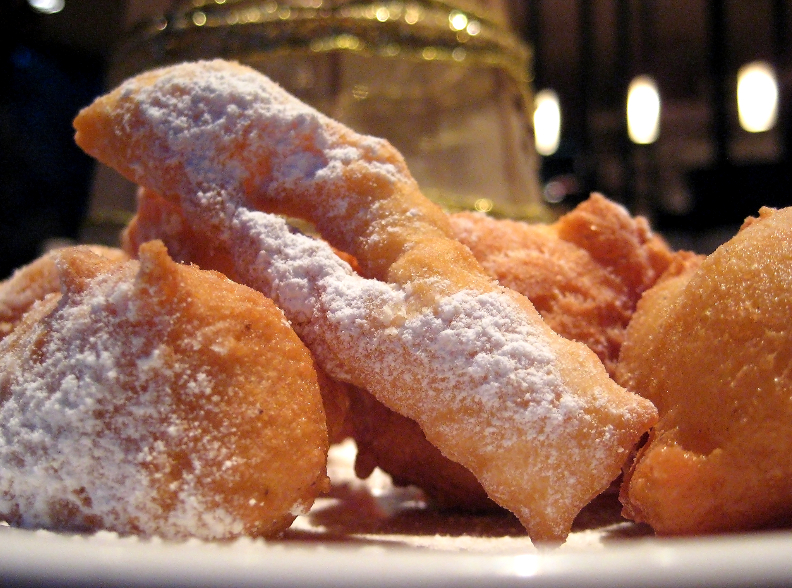 Kroštule and fritule — an inseparable holiday pair. Photo: Wikimedia Commons (source file)
Mediterranean relatives
Kroštule belong to the great Mediterranean family of fried strips of dough — the Italian chiacchiere, crostoli and galani, to which they owe their name too, are fried for Carnival from Venice to Sicily. They reached the Croatian coast by the Venetian routes, like fritule, and settled in so thoroughly that today they are an inseparable part of the local holiday heritage, with recipes passed from nonna to granddaughter.
Like all fried sweets of the old Mediterranean, kroštule too were once a dish of special days — because eggs, fat and sugar were precious, and frying a real little rite. Today they are fried far more often, but they have not lost their holiday aura: a platter of kroštule on the table still means something is being celebrated.
The secret of bubbles and crumbliness
A perfect kroštula is thin, crumbly and full of bubbles — and three secrets lead to that. The first is brandy in the dough: a spoonful or two of grappa, herbal brandy or rum (as with fritule) prevents oil absorption and gives crumbliness; the alcohol evaporates during frying. The second is rolling thin — the dough is rolled almost to transparency, because a thick kroštula stays hard and bready inside.
The third secret is rested dough: half an hour under a bowl relaxes the gluten, so the dough can be rolled thin without springing back. And the bubbles, the pride of every nonna? They form on their own — from well-kneaded, thinly rolled dough that suddenly meets hot oil. Where there are bubbles, there is crumbliness.
Ingredients
For about 40 kroštule:
- 400 g plain flour
- 2 eggs + 1 egg yolk
- 3 tablespoons sugar + vanilla sugar
- 40 g butter, melted (or 3 tablespoons oil)
- 0.5 dl brandy (grappa, herbal brandy) or rum
- 0.5–1 dl milk or white wine (as needed)
- grated zest of 1 lemon (and orange, if you like)
- a pinch of salt
- oil for frying (about 1 l)
- icing sugar for dusting
Preparation
- Make the dough. Mix the eggs and yolk with the sugar, vanilla sugar, salt, lemon zest, butter and brandy. Gradually add the flour and enough milk (or wine) to get a smooth, medium-firm dough — softer than noodle dough, firmer than yeast dough.
- Rest. Knead the dough for 5–10 minutes until it is elastic, then cover it with a bowl and leave it for 30 minutes.
- Roll thin. On a floured surface roll the dough, piece by piece, to a thickness of 2–3 millimetres — the thinner, the crumblier.
- Cut strips. With a fluted pastry wheel (or a knife) cut strips 3–4 cm wide and 12–15 cm long.
- Tie the bows. In the middle of each strip make a lengthwise slit and pull one end of the strip through it — you get the classic bow. (You can also keep it simpler: just lightly twist the strips.)
- Fry. In a deeper pot heat plenty of oil to a medium-high temperature (about 170 °C). Fry the kroštule in smaller batches, a minute or two per side, until they are golden and full of bubbles.
- Drain and dust. Lift them out onto kitchen paper, then, while still warm, dust them generously with icing sugar. Once cooled, they are even crispier.
Tips for perfect kroštule
- Roll thinner than you think — at 2 mm a kroštula is crumbly; at 5 mm it is a doughnut.
- Do not skip the brandy: it is the reason nonna's kroštule are not greasy.
- Medium-hot oil — too hot burns them before they dry inside; a test strip before the first batch is a must.
- Do not overcrowd the oil; kroštule need room to make bubbles.
- Dust them warm, eat them cold — the sugar takes on a warm kroštula, and full crispness arrives with cooling.
What to serve with them
Kroštule are arranged on a large platter — best in the company of fritule, with which they make the classic holiday duo — and served with coffee, tea, mulled wine or a shot of prošek. They are also excellent with creamy desserts like rožata, to which they give a crunchy contrast.
Kept in a tin, they stay crispy for days — in theory. In practice, kroštule are a sweet that vanishes in passing: everyone who walks past the platter takes "just one" — and so on to the bottom.
The most common mistakes
The most common mistake is too-thick dough — the kroštula turns out hard and pale inside; roll to transparency. The second is the wrong oil: too hot gives dark, bitter edges, too cool a greasy, heavy kroštula — sacrifice a test strip and tune the heat. The third is unrested dough, which resists rolling and springs back; half an hour of rest solves everything.
Take care too that the bows are not pulled too tight — a strip pulled too firmly stays raw at the knot. And finally: dust generously, but only on the paper, not in the hot oil. Sugar in the pan burns; sugar on a kroštula — celebrates.
Conclusion
Kroštule are proof that from the simplest ingredients — flour, eggs and a shot of brandy — come the things by which holidays are remembered. Their crunch is the sound of an Adriatic Christmas and Carnival, and their bow a little reminder that food can be a gift too. Roll thin, fry carefully, dust without stinting and arrange them on a platter with fritule. And then top the platter up straight away — because the first batch of kroštule, as all nonnas from Umag to Konavle know, never lasts until the guests.