Medvednica Nature Park: Zagreb's mountain above the capital
Few capital cities in the world have a real mountain practically in their backyard. Zagreb does — Medvednica, "Zagreb's mountain", a green ridge that rises right above the city and that has for centuries been the people of Zagreb's outing spot, refuge and lungs. It is enough to take a tram, change to the cable car and, in a little over a quarter of an hour, find yourself at the summit, in an entirely different world — among beech forests, medieval ruins and fresh mountain air.
Protected as a nature park, Medvednica is the most visited park of its kind in Croatia precisely because of its nearness to a city of a million people. But it would be wrong to reduce it to a city promenade. Beneath its forests hide caves and old mines, on its slopes stand fortresses and churches, and through its legends weave black queens and hidden treasure. Medvednica is a mountain that combines everyday recreation with deep history and wilderness.
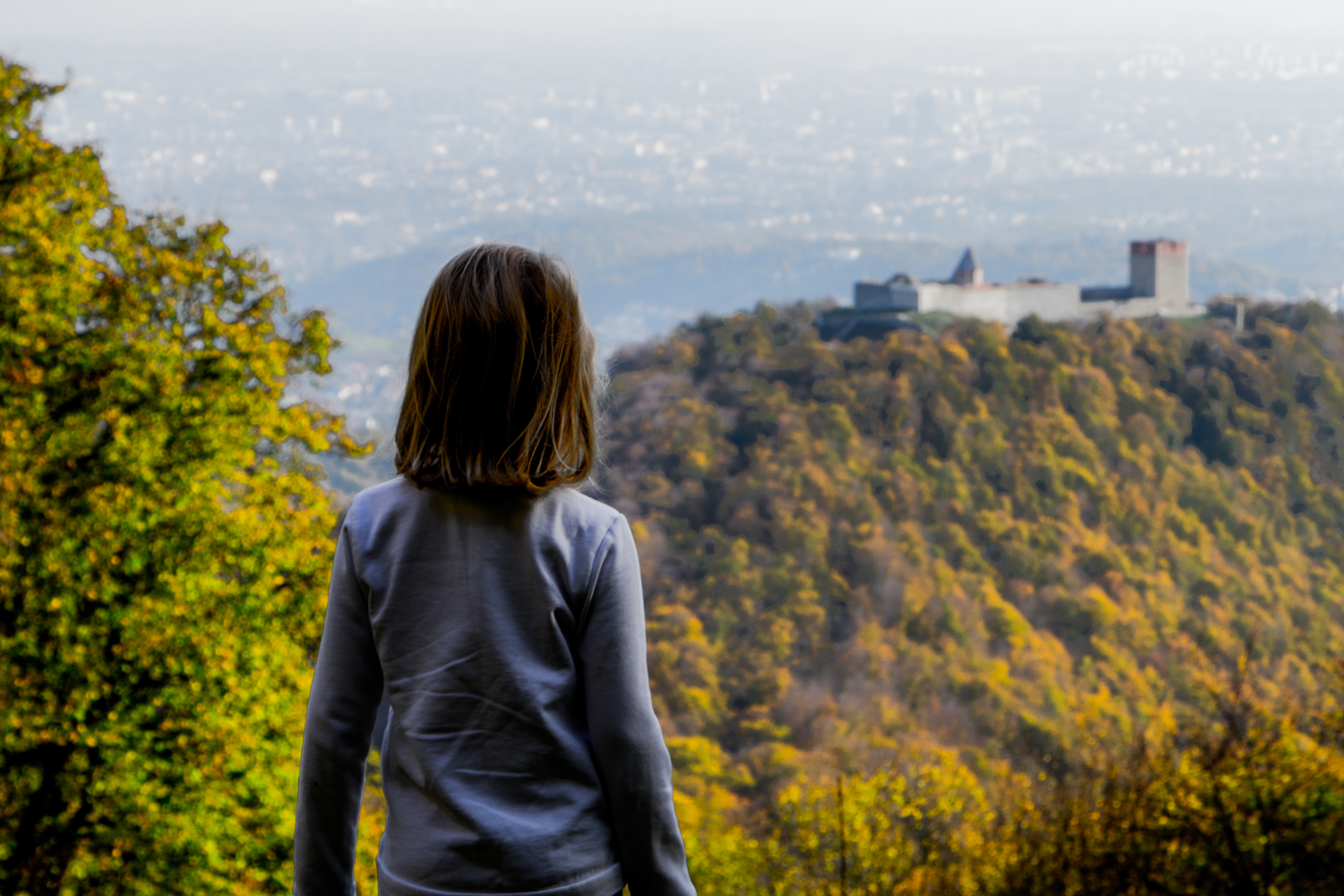
 The medieval fortress of Medvedgrad above Zagreb. Photo: Wikimedia Commons (source file)
Sljeme: a peak near the city
The highest peak of Medvednica is Sljeme, which rises to about 1,035 metres. For the people of Zagreb it is an almost sacred place — the goal of Sunday ascents, the starting point of hiking trails and a symbol of escape from the city bustle. At the summit stand a tall television tower, mountain lodges and restaurants, and on a clear day the view reaches unbelievably far, all the way to Velebit in the south and the snowy peaks of the Julian Alps in the north-west.
Sljeme can be reached on foot by numerous trails, by car or — most spectacularly — by cable car (gondola), which in a little over fifteen minutes lifts visitors from the foot to the summit, offering a view of the whole city along the way. It is precisely that ease of access that makes Medvednica unique: a real mountain with a real peak, and yet accessible to everyone, regardless of fitness.
Medvedgrad: the fortress that watches over Zagreb
On the southern slopes of Medvednica, halfway from the city to the summit, stands Medvedgrad — a medieval fortress built in the mid-13th century, after Zagreb was devastated by the Mongols. Over the centuries it changed some one hundred and fifty owners, among them kings, viceroys and noble families, before an earthquake turned it into a ruin. In the 20th century it was partly restored and today it is a favourite outing spot with a magnificent view of the city.
Below the main tower is also the Altar of the Homeland, a monument dedicated to the Croatian defenders who fell in the Homeland War, ceremonially opened in 1994. With that, Medvedgrad became not only a historical monument but also a place of national memory — a point where history, nature and contemporary identity meet above the capital.
The legend of the Black Queen
No story of Medvedgrad is complete without the Black Queen — Barbara of Cilli, a historical figure of the 15th century around whom a whole wreath of legends was woven. According to tradition, she was a cruel and dissolute mistress who terrorised the surrounding area, always dressed in black, with a black raven as her companion, absorbed in politics, astrology and alchemy.
Legend says the Black Queen sold her soul to the devil and hid an enormous treasure guarded by a serpent in the tunnels beneath Medvedgrad. Some also attribute to her the creation of the Kraljičin zdenac (Queen's Well) spring, a popular hiking crossroads. Regardless of how much of it all is history and how much imagination, the story of the Black Queen gives Medvedgrad that dark, fairy-tale charm for which visitors remember it — a fortress with a ghost, a treasure and a curse.
Veternica: a glimpse into the underground
Medvednica is rich not only on the surface. In its limestone body dozens of caves have been recorded, and the best known and longest among them is Veternica — one of the longer caves in Croatia, part of which is arranged for visitors. Traces of prehistoric man and the remains of the cave bear — a long-extinct beast after which, possibly, the whole mountain is named — have been found in it.
The descent into Veternica is a journey into a cold, quiet underground world of stalactites and stalagmites, but also into a deep past — a place where, tens of thousands of years ago, both people and bears found shelter. Alongside Veternica, the mountain hides numerous other, undeveloped caves that still attract speleologists today.
The Zrinski mine: silver beneath the mountain
Few people know that silver, lead and other metals were once mined beneath Medvednica. Near the Grafičar mountain lodge lies the restored Zrinski mine, part of a former mining system reaching back centuries, to the time when the powerful Zrinski family exploited the mountain's mineral wealth.
Today part of the mine is arranged as an educational site through which visitors can pass and peer into the world of the former miners. That underground passage testifies that Medvednica was not only an outing spot but also an economic resource — a mountain from whose depths treasure of an entirely real kind was extracted for centuries, long before the legends of the Black Queen's hidden gold.
Forests, reserves and wilderness
Despite its nearness to a city of a million, Medvednica is surprisingly rich in nature. Its slopes are covered by dense forests of beech, fir, sessile oak, maple and ash, several of which are protected as special forest reserves because of their exceptional value. In these forests live roe deer, wild boar, foxes, martens and numerous other animals, and birds of prey circle the sky.
That biological diversity is the reason Medvednica is protected at all. As a mountain on the edge of the city, it is at once under constant human pressure and a precious refuge of nature — a green island that gives Zagreb clean air, shade and a connection to a wilderness that would otherwise be far away.
The Snow Queen: skiing above Zagreb
In winter Medvednica takes on an entirely different face. On its northern slopes, below Sljeme, lies a ski slope that has become known all over the world — because it is precisely here that the Snow Queen is held, a Ski World Cup slalom race. Few capital cities can boast that top-level ski competitions are held practically within their boundaries.
For the people of Zagreb, skiing on Sljeme is part of their identity, and for the world's skiers Medvednica is a special, somewhat unusual challenge — a mountain above a city of a million, with stands full of fans. Thus Medvednica combines what is rarely combined: urban bustle and winter sport on a real mountain.
The capital's playground
More than anything, Medvednica is the recreational heart of Zagreb. At weekends its trails fill with walkers, runners, cyclists and hikers of all ages, who climb toward Sljeme or tour the numerous mountain lodges scattered across the slopes. Educational trails, children's playgrounds, viewpoints and refreshment stops make it accessible to all.
That role of a city outing spot is more than a century old and part of Zagreb's everyday life. For many city residents Medvednica is not a distant mountain but an extension of the living room — a place to go for a coffee with a view, a Sunday climb or simply a breath of fresh air above the city haze.
Through the seasons
Medvednica is beautiful at any time. Spring wakes the forests and covers the slopes with flowers, and the temperatures are ideal for ascents. Summer offers shade and freshness while the city bakes, so the mountain is a favourite escape from the heat. Autumn colours the beech forests in gold and crimson and brings clear air with the furthest views. Winter often turns the mountain white with snow, making Sljeme a ski slope and a winter playground near the city.
An island in an ancient sea
Few people, walking on Medvednica, imagine that this mountain was once — an island. In the geological past, millions of years ago, this whole area was covered by the vast Pannonian Sea, and Medvednica rose from it like a solitary island. Traces of that ancient sea can still be read today in its rocks and fossils, in deposits of limestone formed from marine organisms.
That deep geological story gives Medvednica an added dimension. It is not only a Zagreb outing spot but also a witness to a vast past in which today's continental Croatia lay under the sea. For geologists and nature lovers the mountain is an open book in which the making of the Central European landscape can be read.
A few curiosities to close
Medvednica abounds in details that surprise even the people of Zagreb. It is the most visited nature park in Croatia, precisely because of its nearness to the capital. Its name means "bear mountain", and in the Veternica cave the remains of a cave bear were found, after which it may be named. On its ski slope the world-famous Snow Queen race is held, so Zagreb is one of the few capitals with a Ski World Cup competition practically within its boundaries. And beneath the mountain hide real old mines where silver was once extracted.
All this makes Medvednica a park that combines the almost incompatible — city everyday life and wilderness, medieval legends and top-level sport, an ancient sea and a modern capital — within reach of every Zagreb resident.
A practical guide to visiting
- Getting there. Medvednica rises right above Zagreb. Sljeme is reached by a road, numerous hiking trails and the cable car (gondola) from the upper part of the city — the fastest and most spectacular way up.
- Tickets. Entry to the park is mostly free; certain facilities such as the cable car, the Veternica cave and the Zrinski mine are charged. Check the opening hours of these sites.
- Trails. A network of marked trails covers the whole mountain, from easy walks to more demanding ascents; numerous mountain lodges offer refreshment.
- Sights. Do not miss Medvedgrad with the Altar of the Homeland, the Veternica cave, the Zrinski mine and the viewpoints looking over the city.
- Footwear and gear. For the higher trails sturdy shoes are essential; the summit is considerably colder than the city, so bring a warmer layer, especially in winter.
- Rules. Move on marked trails, do not leave litter and respect the protected forest reserves.
- Combine with the surroundings. Zagreb itself with its Upper Town and Maksimir, and nearby Croatian Zagorje with its castles, make Medvednica a perfect part of a wider outing.
Conclusion
Medvednica is proof that you need not travel far for a real mountain, a medieval fortress, a dark legend and an underground world — it is enough to look north of Zagreb. It is at once a city outing spot and a wild mountain, a place for a Sunday coffee with a view and a place where cave bears and the Black Queen's treasure are hidden. Whether you ride up by cable car, walk to Medvedgrad or descend into Veternica, Medvednica welcomes you as what it has been for centuries — a green crown above the capital.