Mljet National Park: a green island, salt lakes and Odysseus's haven
There is an island in the southern Adriatic that even the ancient Greeks believed was too beautiful to leave easily. According to legend, it was on Mljet that the captive Odysseus spent seven years with the nymph Calypso, unable to tear himself away from its beauty. Anyone who sails today to the western part of the island — to the pine forests that descend all the way to the sea and to two calm salt lakes hidden among them — will find it hard to resist the same feeling.
Protected as far back as 1960, Mljet National Park is the oldest marine national park in the Mediterranean and covers the western third of the island of Mljet, the greenest and most forested of the larger Adriatic islands. There are no dramatic waterfalls or bare rock here; Mljet is a park of silence, shade and blue-green water — a place made for slow, Mediterranean enjoyment.
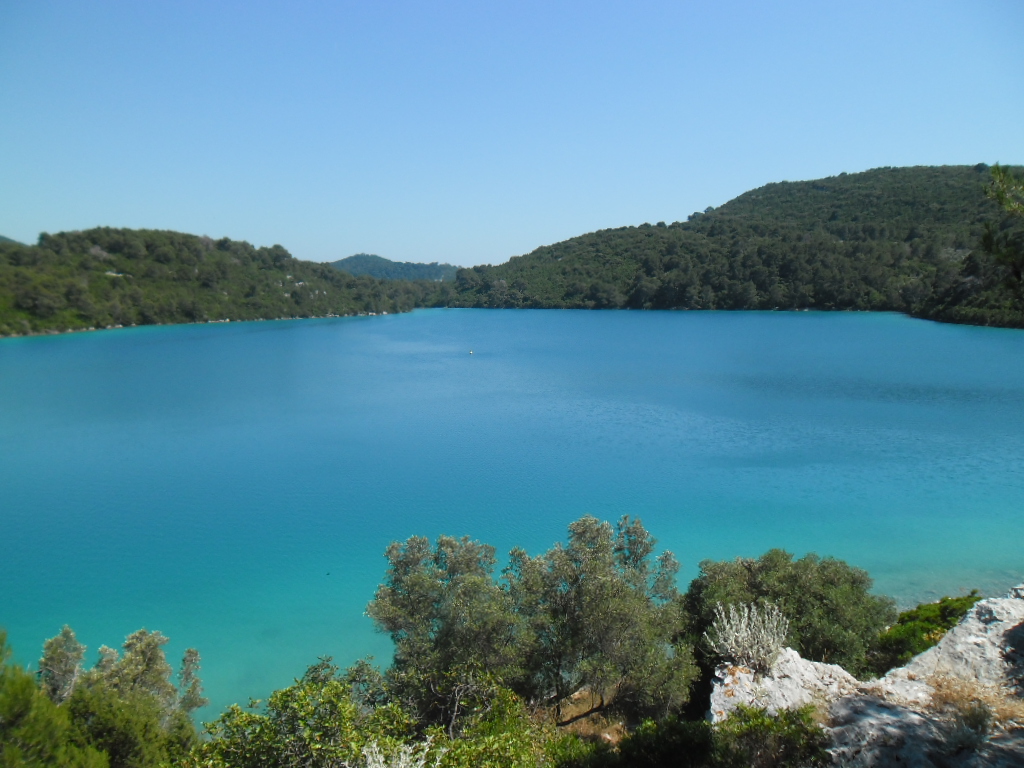
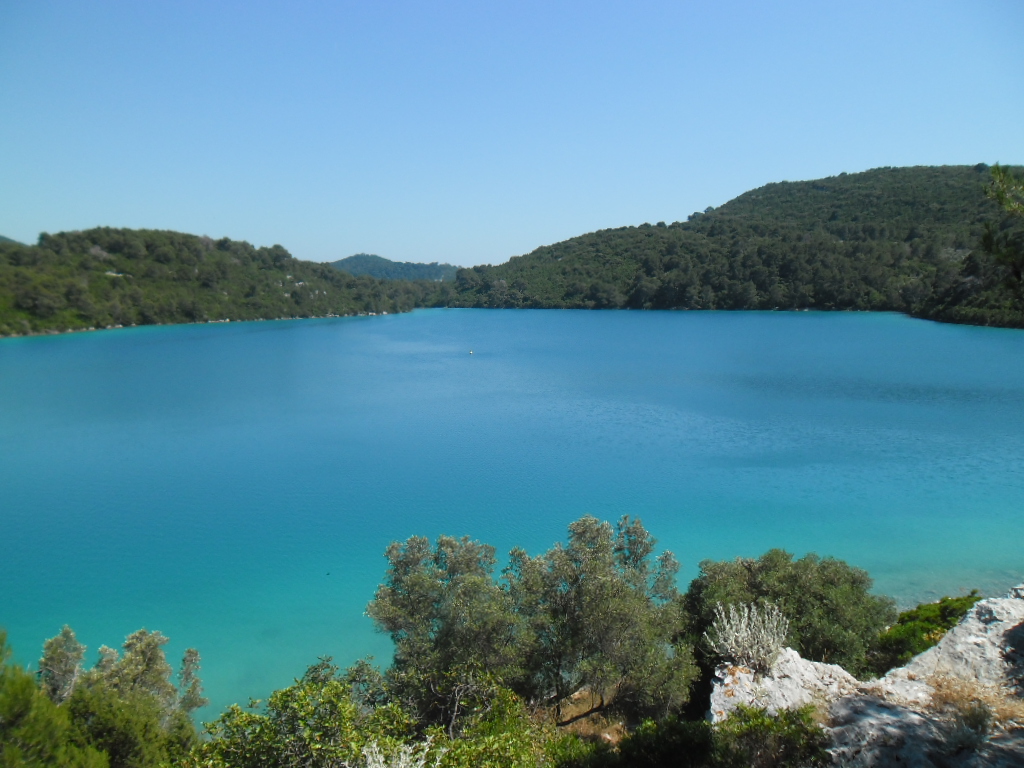 The Small Lake, surrounded by dense pine forest. Photo: Wikimedia Commons (source file)
Two salt lakes: a natural phenomenon
The heart of the park is formed by two deep, sea-filled inlets that, because of their narrow passages to the open sea, are called lakes — the Great Lake and the Small Lake. These are no ordinary lakes: they formed when, after the last ice age, the sea rose and flooded the former karst valleys. Some ten thousand years ago these were freshwater lakes, and then the sea, breaking through the limestone by way of a narrow channel, turned them into salt lagoons.
This link to the sea gives the lakes unique properties. The water in them is somewhat less salty than the surrounding sea, and their temperature is higher in summer and lower in winter than the open Adriatic. Through the narrow Soline channel the sea exchanges slowly, according to the tides, creating a strong current at the spot called the Little Bridge. The result is warm, calm, clear water ideal for swimming — a phenomenon so rare and valuable that it was precisely this that was the main reason for protecting Mljet so early.
The Benedictine monastery on St Mary's
In the middle of the Great Lake lies an islet on which stands one of the most idyllic sights of the Croatian Adriatic — the Benedictine monastery of St Mary (Melita). The Benedictines arrived here in the 12th century and built a church and monastery on the small island within the lake, an island within an island, surrounded by pines and turquoise water.
Over the centuries the monastery changed its appearance and purpose — it was a religious centre, and for a while even served as a hotel — and today it is a favourite destination for visitors. A little boat runs to it from both sides of the lake, and many reach the islet by kayak, which is a special experience. To sit in the shade beside the old church, while the water around you shifts through shades of green, is one of those moments for which Mljet is remembered.
Odysseus and Calypso: myth inscribed in the coast
Mljet is deeply woven into ancient mythology. According to one of the most famous tales, it was here, in Odysseus's cave on the island's southern shore, that the Greek hero stayed, held captive by the love of the nymph Calypso. The cave still bears his name today, and is reached by boat or by a hiking trail; when the sun breaks through an opening in the roof and lights up the blue water, it is easy to understand why magic was attributed to it.
Alongside Odysseus, the island is also linked to the biblical story of the shipwreck of St Paul — some researchers believe that the legendary "Melita" of the Acts of the Apostles refers precisely to Mljet, and not to Malta. Whether these stories are history or imagination, they give Mljet a layer of ancient, Mediterranean mystique that complements its natural beauty.
Pine forests and the underwater world
Mljet is rightly called the green island: almost ninety per cent of its surface is covered by forest, dominated by the Aleppo pine, introduced back in antiquity, recognisable by its curved trunks and the scent of resin in the sun. Alongside it grow holm oak and manna ash, and in many places the forests descend all the way to the edge of the lakes and the sea, creating that characteristic Mljet harmony of green and blue.
Nor does the underwater world lag behind. In the Great Lake hides the only coral reef in Croatia, and the clean waters around the island attract divers from all over Europe. On land, meanwhile, you may come across a mongoose — an animal that is not native but was introduced at the start of the 20th century to suppress venomous snakes, and so became part of the Mljet story itself.
The only park where you may swim in the lakes
Most Croatian national parks strictly forbid swimming in their waters — but Mljet is an exception. Thanks to the fact that its lakes are in fact salt sea lagoons, swimming in them is permitted, so Mljet is the only national park where visitors may swim without a care in the middle of a protected natural phenomenon.
The warm, calm water of the Small and Great Lakes is perfect for swimming, and kayaking and non-motorised sailing are also allowed. This makes Mljet an ideal park for families and for anyone who wants to experience nature not only with the eye but with the whole body — floating on your back in the middle of forest and silence.
Roman Polače and traces of the past
Mljet is not only nature and myth. In the settlement of Polače, the main harbour in the northern part of the park, stand the impressive remains of a late-antique Roman palace from the 5th century — so large that today's road runs through the middle of it. Beside it are the remains of early Christian churches and a late-antique fortress, testimony that Mljet was a prized refuge even in ancient times.
The island was for centuries also the estate of the Dubrovnik nobility and of the Benedictine order, and that layered past — Greek, Roman, medieval, Ragusan — gives Mljet a depth that surpasses its postcard image.
How to get around the park
Mljet is made for slow exploration. The two main entrances to the park are the villages of Polače and Pomena, and from them pleasant, mostly shaded forest paths lead to the lakes. The loveliest way to tour is by bicycle — both lakes are ringed by walkable paths suitable for cycling and strolling, and bicycles can be rented in several places. The alternative is a kayak, in which you reach the monastery and hidden coves at your own pace.
For a broader picture it is worth climbing the Montokuc viewpoint, from which a view opens over the whole park, the Pelješac peninsula and, on a clear day, all the way to Korčula and Lastovo.
Through the seasons
Mljet is at its loveliest from late spring to early autumn. Spring wakes the forest and fills the lakes with pleasantly warm water, with few visitors and ideal conditions for cycling. Summer is the height of the season — warm lakes, long sunny days and the most guests from excursion boats; come early to avoid the crush on the little boat to the monastery. Autumn brings soft light, a still-warm sea and calm. Winter is quiet and damp; the park is then almost empty, and the island shows its most intimate, solitary face.
Mongooses, snakes and the balance of nature
One of Mljet's most unusual stories is tied to a small, nimble animal that does not belong here at all — the mongoose. At the start of the 20th century it was introduced to the island with the intention of reducing the number of venomous snakes, above all the horned viper. The mongoose did its job all too well: it did indeed thin out the snakes, but then, with no natural enemies, it multiplied and began to hunt birds, lizards and other native species.
That episode serves today as an instructive example of how dangerous it is to introduce foreign species carelessly into a sensitive ecosystem. Visitors still often spot the mongoose darting through the low undergrowth beside the paths — a reminder that the park's nature is not a museum exhibit but a living web of relationships in which every move has consequences.
Wealth hidden in silence
Although Mljet seems calm and gentle, its natural diversity is great. The dense pine forests are home to numerous birds — the island lies on a migration route, so more than a hundred species are recorded here over the year, and a good number of them nest. Falcons and eagles hunt along the coastal cliffs, and owls call at dusk.
The seabed is a chapter of its own: alongside the aforementioned coral reef in the Great Lake, Mljet's coves and shoals hide a rich world of fish, sponges and shellfish. That is precisely why the sea is part of the protected area, with a coastal belt included in the park. For divers and those who love snorkelling, Mljet offers an experience rarely found within the boundaries of a single national park.
Why Mljet is different from the other parks
Every Croatian national park has its own character, and Mljet's is — peace. While Plitvice and the Krka celebrate the power of water, and Paklenica and Velebit height and wilderness, Mljet celebrates harmony: a forest that touches the sea, lakes in which you may swim, a monastery that has rested on an island in the middle of a lake for centuries. Here you do not conquer summits or count waterfalls; here you slow down.
That serenity makes Mljet ideal for families, for couples and for anyone who seeks renewal from nature rather than adrenaline. It is no accident that many visitors describe it as the place hardest to leave — just as, according to legend, even Odysseus could not easily sail away.
A few curiosities to close
Mljet hides facts that surprise even those who think they know the Adriatic. It is the only Croatian national park where swimming is permitted in the very protected water phenomenon, because its "lakes" are in fact salt sea lagoons. In the Great Lake lies the only coral reef in Croatia. The islet with the monastery of St Mary is an example of a rare geographical puzzle — an island on a lake that is on an island. And according to some researchers, it is Mljet, and not Malta, that is the biblical "Melita" on which St Paul was shipwrecked.
All this makes Mljet a park that rewards curiosity as much as relaxation: you can cycle across it in a single day, but you will discover that every corner of it — from Odysseus's cave to the Roman palace in Polače — hides yet another story worth a visit of its own.
A practical guide to visiting
- Getting there. Mljet is reached by ferry or catamaran from Dubrovnik, and by car via the ferry line Prapratno (Pelješac)–Sobra. Excursion boats dock in Polače and Pomena, the main entrances to the park.
- Tickets. The entrance ticket is bought at kiosks in Polače or Pomena; maps and information leaflets are available there too. The price is higher in the summer season.
- Getting around. It is best to rent a bicycle and tour the lakes along the paths, or to rent a kayak. Cars do not go down to the lakes.
- The monastery. A little boat runs to the islet of St Mary in the Great Lake (usually included in the ticket); check the departure schedule on arrival.
- Swimming. Unlike the other parks, swimming is allowed in the lakes — bring a swimsuit and towel.
- Bring. Water, sun protection and comfortable footwear; although there is plenty of shade, the southern summer heat is pronounced.
- Combine with the surroundings. The rest of the island of Mljet (sandy beaches in the east, the village of Babino Polje, Odysseus's cave) and the proximity of Dubrovnik and Korčula make Mljet a perfect part of a broader southern-Adriatic tour.
Conclusion
Mljet wins not with spectacle but with subtlety. There is no roar of waterfalls or dizzying cliffs — there is the scent of pine, a silence threaded with cicadas, water that shifts through shades of green and an old church on an island in the middle of a lake. It is a park for slowing down, for aimless cycling and for long floating in warm water while forest surrounds you. If Odysseus really did spend seven years here, it is hard to blame him — Mljet is an island to which, once you know it, you always long to return.