Plitvice Lakes: Croatia's symphony of water, tufa and colour
There are places that are not visited — they are experienced. The Plitvice Lakes are one of them. Sixteen lakes strung down an overgrown mountain valley, joined by waterfalls that never rest, while the water shifts colour from turquoise to emerald and then to steel-grey, depending on the minerals, the tiny organisms and the angle at which the sun falls on the surface that minute. Hidden between the slopes of Mala Kapela and Lička Plješevica, the lakes were for centuries an almost inaccessible pearl in the midst of dense forest — and today they are Croatia's most visited natural wonder and one of its most recognisable symbols.
It is no wonder that this was the first Croatian national park, declared back on 8 April 1949, and that UNESCO included it on the World Heritage List as early as 26 October 1979. But figures and dates are only the frame. To understand why this place leaves people breathless, we must begin with the story that has been told here for generations.
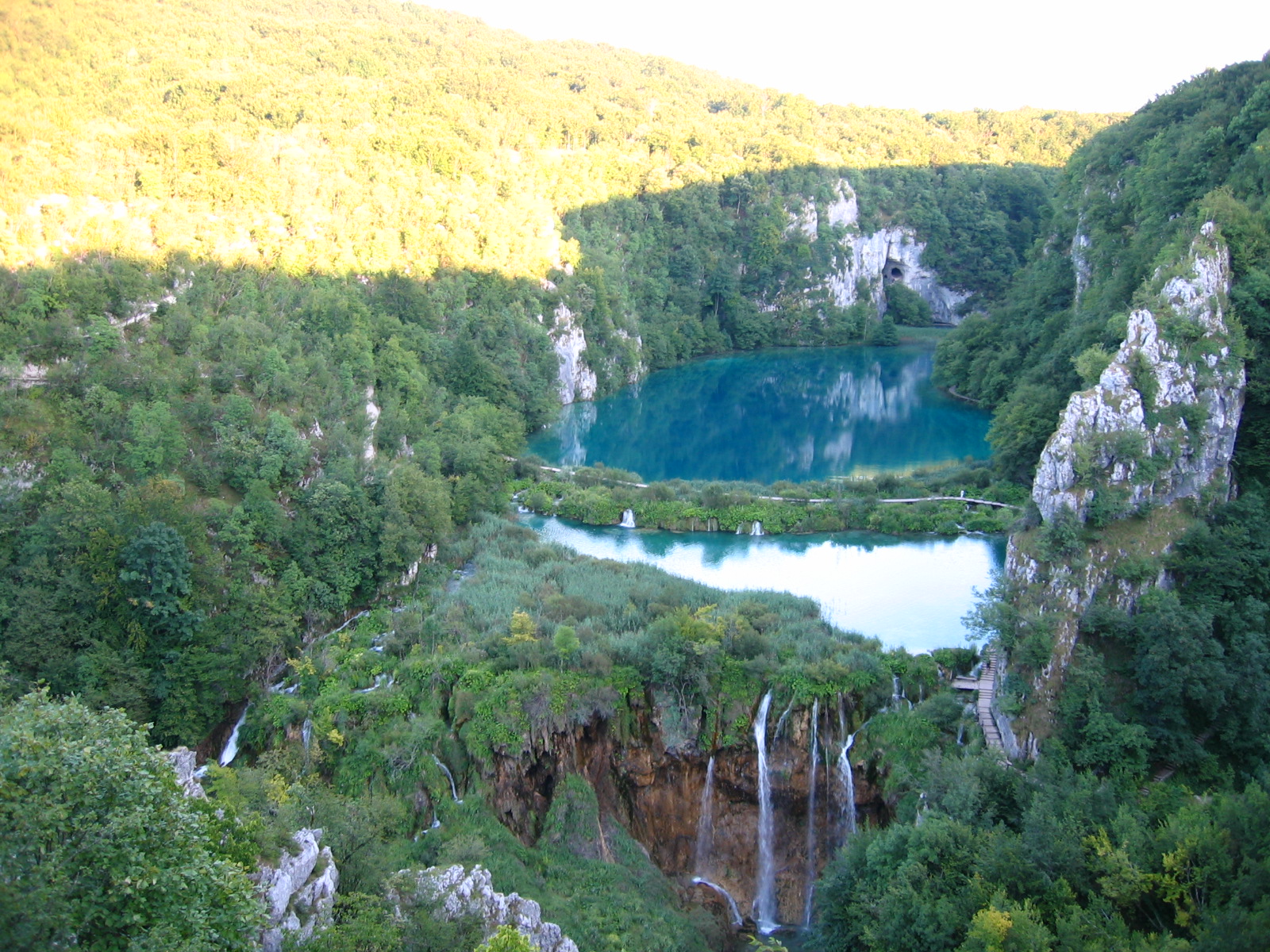
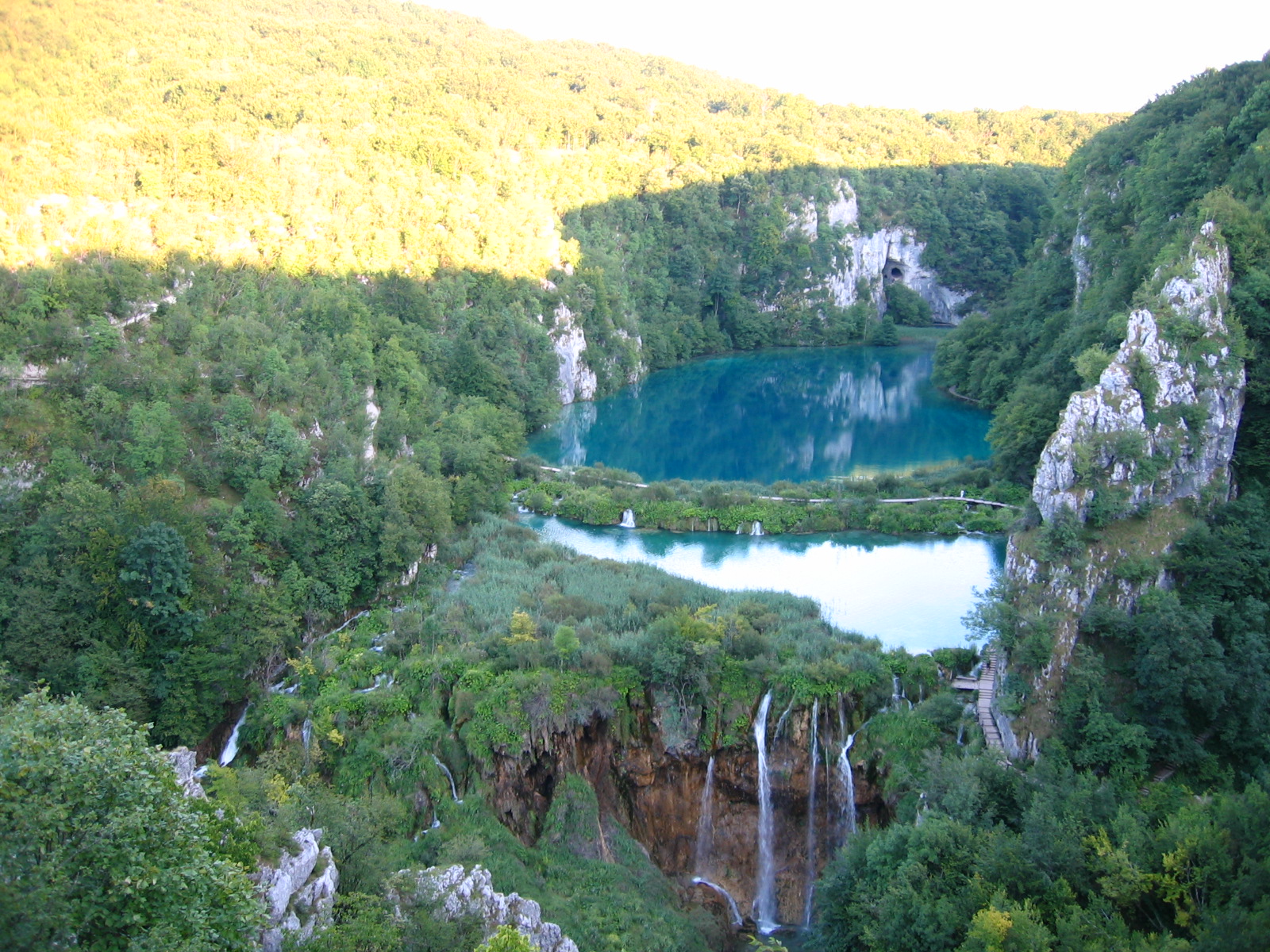 Panorama of the Lower Lakes. Photo: Wikimedia Commons, licence CC BY-SA 3.0
The legend of the Black Queen
Before scientists explained how the lakes came to be, the people of this region had their own explanation — far lovelier than geology.
The story goes that long ago the whole region was struck by a terrible drought such as no living soul could remember. Even the Black River, a source that never dries up, ran dry. Trees toppled, the soil crumbled to dust, and people and animals died of thirst. The exhausted people prayed for days for salvation. Their prayers were finally heard by the Black Queen, a good fairy who reigned in the fairy halls of Velebit. She descended with her retinue into the valley and promised rain in abundance. Amid lightning and thunder a downpour fell that lasted for days, until the bed of the Black River overflowed into a series of lakes whose beauty recalled emeralds.
The first lake, according to legend, was named Prošćansko — in memory of how the people "begged" (prosili) for water from the merciful queen. The story does not end there: the queen remained watching over the region, and when the water once rose dangerously from Galovac, threatening a flood, she appeared again and calmed the surge. On parting, tradition says, she uttered a prophecy — that many armies would pass through this region and much blood and many tears would be spilled, but that better times would one day come and that "gentlefolk from all over the world" would come to the lakes. Anyone who has seen today's columns of visitors from every corner of the earth can hardly escape the impression that the prophecy came true.
The science behind the wonder: living stone that builds its own waterfalls
The legend is lovely, but the reality is just as fascinating. What makes Plitvice unique is not only its beauty — but the fact that the park literally builds itself, day by day.
The barriers that separate the lakes are not ordinary stone but tufa (travertine). This is a porous deposit that forms when mosses, algae and bacteria in water rich in calcium carbonate cause crystals of limestone to settle around them. In other words, the barriers are alive: as the moss grows, a new mineral layer accumulates on it, the barrier rises, holds back ever more water and thus creates new lakes, new steps and new waterfalls. The process is slow — a barrier grows by only a few millimetres a year — but unceasing. The landscape you look at today differs from the one visitors saw a hundred years ago, and it will differ from the one those a hundred years hence will see.
That is precisely why the park is extremely sensitive, and why visitors are kept strictly to the wooden bridges and paths. The touch of a hand, treading or bathing can damage a layer of tufa built up over centuries. Water here is not merely scenery — it is a builder, and the tufa is its work.
The Upper Lakes: the park's gentle side
The lake system naturally divides into two parts, and each of the sixteen lakes bears a name with its own story.
The Upper Lakes lie in a broad, forested valley on a dolomite base. Their shores are softer and more spread out, the transitions between lakes gentler, and the whole impression calmer and more idyllic. Here is also Kozjak, the largest and deepest lake in the park, across which electric boats glide silently. The name Kozjak is tied to a wistful legend about some thirty goats that, fleeing wolves in winter, ventured out onto the thin ice of the lake — the ice cracked and the herd drowned.
The Upper Lakes group includes Prošćansko jezero, Ciginovac, Okrugljak, Batinovac, Veliko jezero, Malo jezero, Vir, Galovac, Milino jezero, Gradinsko jezero, Veliki Burget and Kozjak. Many names preserve old tales: Prošćansko some linked to the pruće (rods) and fences with which peasants divided the lakes from arable land, while others remain faithful to the legend of "begging" for water. Above Galovac plunges Galovački buk, one of the park's most photogenic waterfalls, where the water spreads into a fan of smaller streams over green tufa steps.
 The forests and meadows around the lakes are home to bears, wolves and lynx. Photo: Wikimedia Commons, licence CC BY-SA 3.0
The Lower Lakes and the Great Waterfall: a dramatic finale
If the Upper Lakes are an idyll, the Lower Lakes are a drama. Here the water has carved into a narrow limestone gorge, with cliffs rising on both sides and hiding caves such as Šupljara. The transition is steeper, the sound of water louder, the atmosphere more tense.
The Lower Lakes are Milanovac, Gavanovac, Kaluđerovac and Novakovića Brod — and each has its own legend. Milanovac, according to one story, took its name from a shepherd named Milan who drowned in it, and according to another from a miller named Mile who had a mill by the lake. Of Gavanovac tradition claims that on its bottom lies the hidden treasure of the rich man Gavan. Kaluđerovac owes its name to a kaluđer (monk) who supposedly lived in a nearby cave and to whom the locals came for advice. And Novakovića Brod preserves two versions: by one, the outlaw Novaković fell from his horse into the water, and by the other, a man of that name rented out boats here.
At the very end of the gorge awaits the park's star — the Great Waterfall. At a height of about 78 metres it is the tallest waterfall in Croatia. Unlike all the other Plitvice waterfalls, which form as water spills from one lake to another, the Great Waterfall is fed by a separate stream, the Plitvica, which arrives from the west and plunges into the canyon of the river Korana. When the water is high — usually in spring after the snowmelt — its thunder can be heard long before you see it, and a rainbow often plays on the fine droplets in the air.
 The Milanovac waterfalls in the Lower Lakes. Photo: Wikimedia Commons, licence CC BY-SA 3.0
Colours that cannot be photographed
Everyone who has been to Plitvice has tried to capture that impossible turquoise colour — and everyone has discovered at home that the photograph does not convey even half the impression. The colours are not a trick of light but the result of several factors acting together: the exceptional cleanliness and transparency of the water, the minerals dissolved in it, a bed covered in pale tufa that reflects light, and the microorganisms and algae that colour the water.
Because of this the same surface seems jade green in the morning and dazzling azure at noon; after rain it can turn milky grey, and in the late afternoon, when the sun falls at a low angle, the whole lake gleams bronze. This is the key reason it is worth returning to Plitvice: you never see them the same twice.
Life of the park: from eagles to butterflies
Around the water stretches nearly 30,000 hectares of dense beech and fir forest — among it the old-growth forest of Čorkova uvala, one of the few remnants of original, never-felled forest in this part of Europe. This is one of the last European habitats in which the brown bear, wolf and lynx live together, and the forests are also home to a large, stable population of owls.
The wealth, however, is also hidden in the small. More than 320 butterfly species have been recorded in the park, of which almost 250 are nocturnal, along with dozens of caddisfly species — insects whose larvae live precisely in the clean, cold water that Plitvice has. The lakes themselves and their tributaries bear the marks of typical trout waters, so the trout is a frequent inhabitant of the shallows, easily spotted from the bridges by curious visitors. Among the plants a special place is held by the common butterwort, a carnivorous plant of marsh habitats found in Croatia almost exclusively in this area. For the patient visitor who sets off ahead of the crowd, the park is as much an ornithological and botanical experience as a visual one.
Through the centuries: history inscribed in water
The first steps in protecting this region were recorded at the beginning of the 20th century, and the lakes received national-park status in 1949. Tourism, however, began even earlier — the first modest hotels and trails attracted curious travellers back in the days of Austria-Hungary, and later Plitvice became a film backdrop as well, for example for the popular Winnetou westerns filmed in the 1960s.
Recent history has also left a painful mark. Plitvice was the scene of the first armed clashes of the Croatian War of Independence on Easter of 1991, when the Croatian police officer Josip Jović, the war's first casualty, was killed here. During the war the park was occupied and damaged, so UNESCO temporarily placed Plitvice on the List of World Heritage in Danger, from which it was removed only in 1997, after liberation and restoration. Today the lakes once again receive visitors from all over the world — almost as a fulfilment of the prophecy from the old legend.
Four seasons, four different parks
Plitvice has no "bad season" — it has four completely different faces.
Spring is the time of greatest power: the melting snow fills the streams, the waterfalls thunder at full force, and the forest wakes into fresh green. Summer brings the warmest weather and the lushest vegetation, but also the biggest crowds — in July and August the paths can be jammed, so an early arrival is almost essential. Autumn is for many the loveliest: the beeches and maples turn to gold, copper and crimson reflected in the turquoise water, and the light becomes soft and warm. Winter turns the park into a quiet fairy tale — frozen edges of the waterfalls, snow on the bridges and almost complete solitude, with caution because many trails are then closed or slippery and only part of the park is accessible.
A practical guide to visiting
For a stress-free experience, a few tested tips:
- Book your ticket in advance. Tickets are bought online, and at the height of the season there are daily limits on visitor numbers and timed entry slots. A ticket bought on the spot is not guaranteed in summer.
- Choose the right entrance. The park has two main entrances. Entrance 1 is closer to the Lower Lakes and the Great Waterfall — ideal if you want a dramatic start. Entrance 2 is more convenient for touring the Upper Lakes and reaching the boats on Kozjak.
- Follow the marked routes. The sightseeing trails are marked with letters (A to K) according to length and duration — from short two-hour walks to full-day tours joining both lake systems. Choose a route according to your fitness and the time you have.
- Use the transport included in the ticket. The ticket price usually includes the electric boats across Lake Kozjak and the panoramic trains that connect distant parts of the park and save your legs.
- Wear serious shoes. The wooden bridges can be wet and slippery; sturdy, non-slip shoes or trainers are needed, never flip-flops.
- Respect the protection rules. Swimming in the lakes is not allowed, nor is flying drones without a special permit. Keep dogs on a leash, and carry your litter out with you. This is a living, sensitive habitat, not a bathing spot or a picnic zone.
- Getting there. The park lies roughly halfway between Zagreb and Zadar, along the A1 motorway (exits Otočac or Karlovac, depending on the direction). By car it is about two hours' drive from Zagreb, and it is also accessible by regular bus lines.
- Where to stay. Nearby are the park hotels and numerous family accommodations and rooms in the surrounding villages such as Plitvički Ljeskovac and Rakovica — staying close by lets you enter the park the moment it opens, before the buses of day-trippers arrive.
Conclusion: a wonder that is never finished
Plitvice should not be rushed. The best impression is not gained by counting waterfalls but by pausing on a bridge, where beneath your feet flows water that — as you read this — is depositing a new millimetre of tufa and building a landscape for some future visitors. Whether you believe the geologists or the Black Queen, the conclusion is the same: this is a place that, even after sixty years of protection and millions of visitors, has kept the power to silence you. A Croatian wonder that is never finished — and for which it is worth returning in every season.