Risnjak National Park: the green heart of Gorski kotar
If you imagine Croatia only through sea and stone, Risnjak is a park that will change the picture. Here, in Gorski kotar — the most mountainous and forested part of the country, rightly called "the green heart of Croatia" — a mountain rises out of an endless sea of fir and beech forests, and the air is fresh and damp like that of the Central European highlands. Just some fifteen kilometres from the Adriatic, and yet it feels like an entirely different country.
Declared a national park in 1953, Risnjak is one of the least visited and most peaceful Croatian parks — and that is exactly where its charm lies. There are no queues, no crowds, no noise; there is a silence broken only by the rustle of wind in the treetops, the murmur of a spring and, if you are lucky, the distant call of a bird. For those who seek solitude and renewal from nature, Risnjak is a discovery.
 The forested massif of Risnjak in Gorski kotar. Photo: Wikimedia Commons (source file)
A park named after the lynx
The name of the park and the mountain almost certainly comes from the lynx (ris) — the cat that was for centuries the most enigmatic inhabitant of these forests. The lynx is a quiet, solitary and hard-to-spot beast, one of the least studied large predators in Croatia, and a symbol of the wilderness that Risnjak preserves.
The story of the lynx has both a sad and a happy chapter. During the 19th century the lynx was entirely wiped out in this area — it vanished from the very forests that gave the mountain its name. But in the 1970s, thanks to a successful reintroduction project from neighbouring Slovenia, the lynx returned to Gorski kotar. Today it dwells in Risnjak once again, though visitors almost never see it — which, in the case of a wild cat, is perhaps the best sign that the ecosystem is healthy.
The peaks: Risnjak and Snježnik
The roof of the park is formed by two peaks. The highest is Veliki Risnjak (1,528 m), the second-highest peak of the whole of Gorski kotar, from which on a clear day a view opens in every direction — from the sea and the Kvarner islands to the Slovenian Alps. The summit is reached only on foot, on an ascent that takes about three hours from Crni Lug, and the reward is one of the loveliest panoramas in this part of Croatia.
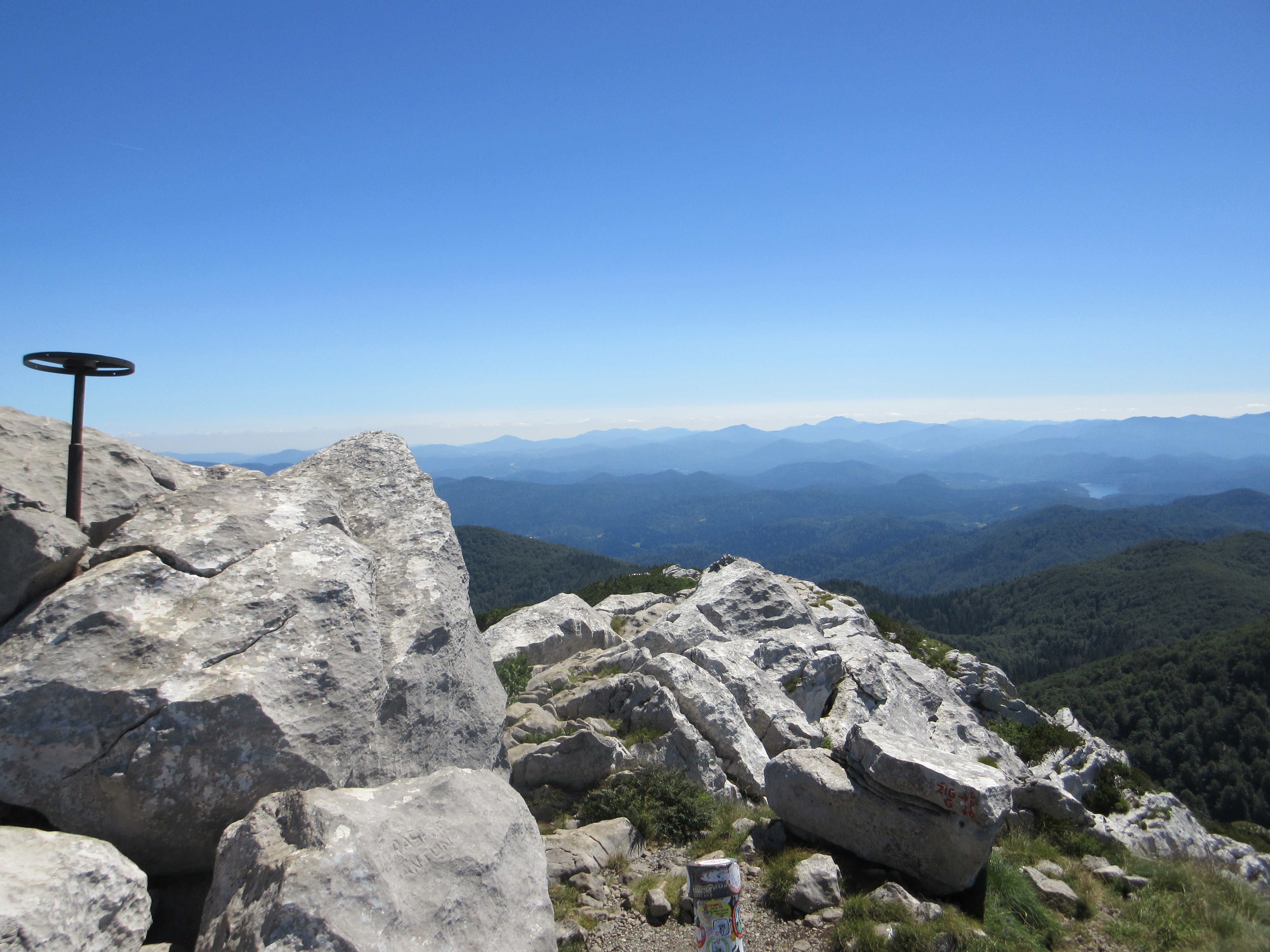
Below the summit, on the southern slope, stands the mountain lodge Schlosser's Lodge, named after the botanist Josip Schlosser, who thoroughly studied Risnjak's flora in the 19th century. The lodge is a classic starting and resting point for hikers. The park's other great peak is Snježnik (1,506 m), whose name ("snowy") comes from the snow that lingers on it for a long time; from its grassy summit a wide view opens toward the sea and the interior, and a favourite tour from nearby Platak leads up to it.
 View from the summit of Snježnik (1,506 m). Photo: Wikimedia Commons, licence CC BY 3.0
The source of the Kupa: the mountain's turquoise eye
If Risnjak has one place remembered forever, it is the source of the river Kupa. Deep in a valley, at the lowest point of the park (about 313 metres), water of an unbelievable, almost unreal turquoise-green colour springs from the rock, gathering in a quiet, deep pool surrounded by forest. The source of the Kupa is one of the deepest and most beautiful river sources in Croatia and a genuine little natural shrine.
A hiking trail leads to the source from the village of Razloge, an ascent that takes about three hours and passes through deep, shaded forest. Beside the source is the visitor centre "Birthplace of the River Kupa", which tells the story of the river that begins its journey here. For many visitors it is precisely this turquoise source that is the highlight of the whole stay in Risnjak.
At the crossroads of four climates
Although Risnjak is not especially high, its position is exceptionally special. The mountain stands at the crossroads of as many as four climatic influences — Mediterranean from the sea, continental from the interior, Alpine from the north and Dinaric from the south. These influences collide and mingle here, creating a damp, changeable and exceptionally diverse climate.
One consequence, among others, is one of the highest amounts of precipitation in Croatia — on the higher parts of the park around 3,600 millimetres of rain fall each year, and the snow can be several metres deep and linger for months. Also interesting is the phenomenon of the so-called sinkholes (dolines), karst depressions in which, because of inverted temperature stratification, cold air lingers at the bottom, so that snow remains in them far longer than in the surrounding, higher places.
Old-growth forests, firs and mountain flowers
Risnjak is above all a kingdom of forest. The park's slopes are covered by dense beech and fir forests, which with altitude give way to sub-alpine beech, and at the highest to a belt of mountain pine (dwarf pine). Around thirty different forest and plant communities have been recorded, and the total number of plant species runs to more than a thousand — which makes Risnjak one of the biologically most diverse areas in the country.
On the bare, rocky peaks grows a special, mountain flora: edelweiss, the mountain cornflower, daffodils and other rare, in places endangered species adapted to the harsh conditions of the heights. For botanists — and it was they who first recognised Risnjak's value — this mountain is a true treasure under the open sky.
Beasts of the deep forest
Risnjak is one of the few places in Europe where all three great European beasts — bear, wolf and lynx — live in the same forests. Alongside them, the park's thickets and meadows are home to red deer, roe deer, chamois and wild boar, while in the treetops and undergrowth hide martens, squirrels and dormice.
The bird life is equally rich: the forests ring with the calls of the capercaillie, the hazel grouse, owls and numerous woodpeckers. Although the visitor will rarely directly encounter a large beast — they are shy and avoid people — the very knowledge that you are walking through a forest where bear, wolf and lynx roam free gives Risnjak a special, almost primeval atmosphere of wilderness.
Leska: a walk through the heart of the park
For those who do not want a demanding mountain ascent, Risnjak offers a perfect introduction — the Leska educational trail. This circular trail, about four and a half kilometres long and laid out in 1993, sets off from the main entrance in Crni Lug and leads through the park's varied habitats, with a series of information boards explaining the forest, its inhabitants and the way nature works here.
The Leska walk is easy and suitable for all ages, taking about one to two hours. It is precisely this trail that is the ideal way to grasp the essence of Risnjak in a short time — its forest, silence and richness — without the need to climb a peak. The park administration, visitor centres and accommodation are concentrated in the village of Crni Lug on the park's eastern edge.
The history of protection
Risnjak owes its status to scientists, above all botanists. The mountain attracted researchers for centuries, and the man most responsible for its protection was the eminent botanist Ivo Horvat, who after years of research proposed that the area be declared a national park. His proposal bore fruit in 1953.
The park was at first smaller, but was expanded over the decades. In 1997 it acquired its present extent, when the Snježnik massif and the valuable area of the source of the Kupa were added. With that, Risnjak rounded out what today makes it complete: from the highest peaks to the turquoise spring in the valley.
Through the seasons
Risnjak is a mountain of four distinct faces. Spring arrives late; snow lingers deep into the year on the higher parts, and when it melts, the forest explodes with green and flowers. Summer is pleasant and cool — while the coast bakes, Risnjak is agreeably shady, so it is an ideal escape from the heat. Autumn is for many the loveliest: the beech forests turn to gold and crimson, and the air becomes crystal clear. Winter is long, snowy and quiet; the park then becomes a white desert where the snow is measured in metres, and some trails become accessible only to the well-equipped.
Why Risnjak is different from the other parks
Risnjak differs from most Croatian parks from the very first breath. While Plitvice and the Krka are marked by water, and Paklenica and Velebit by vertical stone, Risnjak is above all a park of forest and silence — a Central European mountain that has strayed near the Mediterranean. There are no great attractions here to be captured with a camera on the run; here the experience is built slowly, through the scent of fir, cold mist and sounds you hear only once you have grown completely quiet.
That restraint makes Risnjak special. It is a park for hikers, botanists, nature-watchers and everyone escaping the crowds — a place that does not win you over loudly but creeps under your skin. Many visitors describe it as the most intimate of all the Croatian parks: the one where it is easiest to feel alone with nature.
Gorski kotar around the park
Risnjak is not a solitary jewel but part of a wider, magical region. Gorski kotar, which surrounds it, is one of the most forested areas in Europe, dotted with lakes such as Lokvarsko and Bajer, caves, swift streams and small mountain settlements with a tradition of woodcutters and foresters. The climate is harsh, the winters long and snowy, and life has always been adapted to the mountain.
Because of its proximity to the motorway and the city of Rijeka, Risnjak and Gorski kotar are easily accessible, and yet they remain off the main tourist routes. This means that a visitor here can combine mountain and sea in a single day — in the morning the turquoise source of the Kupa deep in the forest, in the afternoon a swim on the Kvarner coast — with barely half an hour's drive between the two. Few regions offer such a range in such a small space.
A few curiosities to close
Risnjak hides facts that surprise even local visitors. On its higher parts as much as 3,600 millimetres of precipitation fall each year — among the highest in all of Croatia — making this one of the wettest points in the country. The river Kupa, which rises at the lowest point of the park, hides in its turquoise source one of the deepest river sources in the state. And the lynx, after which the mountain is named, roams these forests once again after having been entirely wiped out — a rare example of the successful return of a large predator to its former home.
All this makes Risnjak a park that rewards those who devote themselves to it: it is neither loud nor showy, but to those who come to know it, it gives the feeling of having touched real, untouched nature.
A practical guide to visiting
- Getting there. The park lies in Gorski kotar, close to the main road and the Zagreb–Rijeka motorway. The main entrance and administration are in Crni Lug near Delnice, about an hour and a half's drive from Zagreb and less than an hour from Rijeka.
- Tickets and information. Tickets are bought at the entrance in Crni Lug, where you can obtain maps and advice on trails. A ticket is usually valid for several days.
- Trails. For an easy tour, the Leska educational trail (about 4.5 km) is ideal. For hikers, the ascent of Veliki Risnjak from Crni Lug takes about three hours, and to the source of the Kupa from Razloge roughly the same.
- Footwear and gear. Sturdy hiking boots and layered clothing are essential — the weather in Risnjak changes quickly, and rain and mist are common even in summer.
- Accommodation. Crni Lug and the surrounding villages offer family accommodation; for hikers there is also Schlosser's Lodge below the summit (check the opening hours, as it is mostly closed in winter).
- Rules. Move on marked trails, do not leave litter and bear in mind that you are in the habitat of large beasts — do not leave food and do not lure the animals.
- Combine with the surroundings. Gorski kotar also offers lakes (Lokvarsko, Bajer), caves and nearby Platak, and the proximity of Rijeka and Kvarner makes it possible to combine mountain and sea in a single trip.
Conclusion
Risnjak is a park for those who know that nature's greatest luxury is sometimes not spectacle but peace. There are no waterfalls thundering here or cliffs that take your breath away — there is endless forest, a turquoise source hidden in the valley and a silence so deep you can hear your own steps on the moss. It is the green heart of Croatia in its purest form, a mountain to which the lynx has returned home, and where the traveller finds what is ever harder to find elsewhere: solitude, freshness and a sense of untouched wilderness.