Poljica soparnik: a chard pie centuries old
At first glance, soparnik seems almost ascetic: two thin sheets of dough, chard with onion between them, and nothing more. But behind that simplicity hides one of the oldest and most prized dishes of Croatian cuisine — a speciality of Poljica, the historic region between Split and Omiš, baked for centuries on an open hearth, covered with embers and ash. Soparnik is so special that it has been inscribed on the list of protected intangible cultural heritage of Croatia, and its name is protected at the European level too.
For the people of Poljica soparnik is not an ordinary pie but a symbol of identity — a dish made for centuries for holidays, Christmas Eve and great occasions, whose preparation, from stretching the dough to baking under the ash, is passed from generation to generation as a family craft. Today soparnik is served with pride at festivities and in taverns, and in this recipe we show how to make it at home — with a faithful oven version.
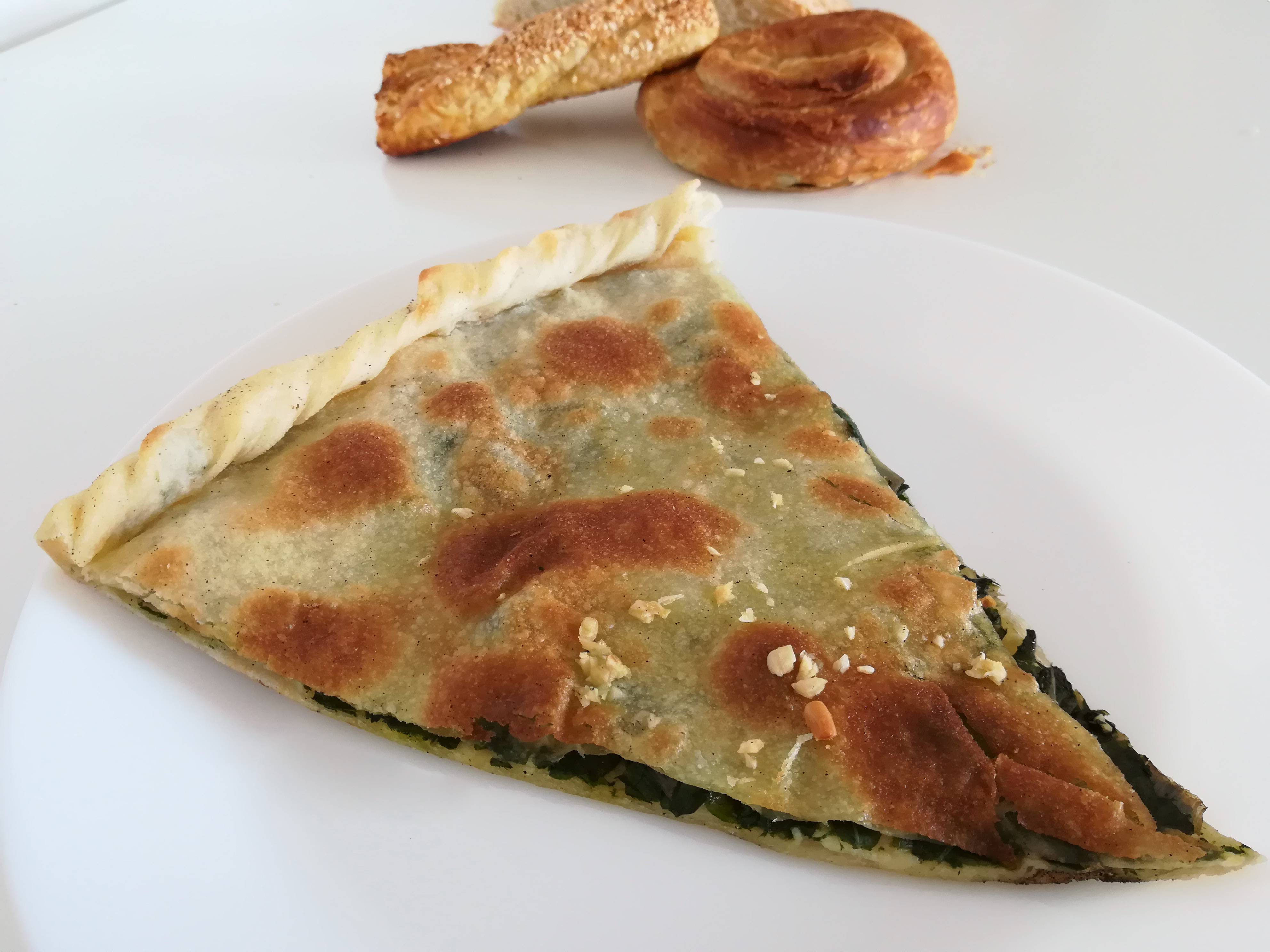
 Poljica soparnik, a thin chard pie. Photo: Wikimedia Commons (source file)
A poor man's dish that became a treasure
Soparnik was born in the karst of Poljica, a region that lived for centuries on little land and much labour. Its ingredients are what every house had: flour, chard from the garden, onion, olive oil and salt. From that scarcity arose a dish of perfect balance — meatless, yet filling; humble, yet festive. Because it is meatless, soparnik was also the traditional dish of Christmas Eve and Lenten days.
Its special quality also lies in the way it is baked: soparnik is baked on the komin — the open hearth — directly on a hot stone slab, and then covered with embers and ash, which bake it from above. It is precisely from that "sopara" (the steam and heat under the ash) that it gets its name. After baking, the ash is swept off and the soparnik is brushed with olive oil and garlic — a moment in which the whole hearth fills with the smell of Dalmatia.
The rules of Poljica soparnik
A real Poljica soparnik has its strict rules. The dough is lean — only flour, water, salt and a little oil — and is stretched into a large, thin circle, traditionally up to a metre in diameter, as wide as the wooden board (sinija) on which it is made. The filling is exclusively chard cut into strips, with spring onion, parsley, olive oil and salt — never cooked in advance, but fresh, so it keeps its flavour and juiciness.
Two sheets of dough are joined over the filling, the edges twisted into the recognisable border (a "braid"), and the finished soparnik is cut into diamonds and eaten warm or cold, by hand. In Poljica its preparation is still considered a ceremonial act, and mastery is proven precisely by the thinness of the dough and correct baking under the ash.
Ingredients
For one large soparnik (8 people, a ~40 cm tray/pan):
Dough:
- 500 g plain flour, or half-and-half with strong flour
- 2.5–3 dl warm water
- 2 tablespoons olive oil
- 1 teaspoon salt
Filling:
- 1 kg fresh chard (leaves only, without the thicker stalks)
- 1 bunch of spring onions or 1 red onion, finely cut
- a bunch of parsley, chopped
- 1 dl olive oil
- coarse salt
For brushing:
- 0.5 dl olive oil
- 2–3 cloves of garlic, pressed
Preparation
- Make the dough. From the flour, salt, oil and warm water knead a smooth, elastic dough. Knead it for about ten minutes, divide it into two equal balls, brush with oil, cover and leave it to rest for 30 minutes.
- Prepare the chard. Wash the chard leaves, dry them well (important — wet chard soaks the dough) and cut them into strips. In a large bowl mix them with the onion, parsley, olive oil and salt. Prepare the filling only just before assembling, so the chard does not release water.
- Stretch the first sheet. On a floured surface (or a large board) roll out and then stretch by hand the first ball of dough into a thin circle larger than the tray — as thin as you dare.
- Assemble the soparnik. Transfer the sheet to a floured tray or board and spread all the filling evenly, leaving a 2–3 cm border free.
- Cover with the second sheet. Stretch the second ball equally thin, cover the filling with it and twist the edges of both sheets together inward into a firm, decorative border. Prick the surface lightly in several places.
- Baking (oven). Bake at 250 °C (the highest your oven gives), preferably on a preheated pizza stone or an upturned tray, for 15–20 minutes — until the dough gets brown spots and, in places, darker, "charred" dots that imitate baking under the ash.
- Baking (komin, original). On the hot hearth stone bake the soparnik directly, then cover it with embers and ash and bake for about 15 minutes. Sweep off the ash with a little brush.
- Brush and cut. Brush the hot soparnik generously with olive oil mixed with pressed garlic. Cut into diamonds and serve warm or cold.
Tips for a perfect soparnik
- Dough thinner than a millimetre is the master's ideal — the thinner, the better the soparnik; thicker dough gives "bread with chard", not soparnik.
- The chard must be dry and freshly seasoned just before assembling, otherwise it releases water and breaks through the dough.
- The highest oven temperature and a hot stone are key to the short, fierce baking a komin gives.
- Garlic and oil at the end are not a garnish but the signature of the dish — without that brushing soparnik is not complete.
- Twist the edge tightly: it holds the filling and gives soparnik its recognisable look.
What to serve with it
Soparnik is traditionally eaten by hand, cut into diamonds, with a glass of homemade red wine or bevanda. It is excellent warm, but many love it best chilled, the next day, when the flavours settle. It is served as a starter, a light supper or a side alongside cheese and prosciutto on a shared board.
Since it is meatless, soparnik is still the star of Christmas Eve dinner in Poljica and the surrounding area — together with cod it forms the holiest duo of a Dalmatian Christmas Eve.
The most common mistakes
The most common mistake is too-thick dough — the soparnik then becomes heavy and bready; practise the stretching, the dough is more resilient than you think. The second is wet or pre-salted chard: salt draws out water, so season the chard literally at the last moment. The third is too low an oven temperature — soparnik is baked short and fierce; at 180 °C you will get a pale, rubbery pie.
And finally, do not skimp on the olive oil and garlic for the brushing — that final touch turns baked dough with chard into a real Poljica soparnik, with the smell by which this dish is remembered.
Conclusion
Soparnik is proof that top-class cooking needs no lavish ingredients — it needs knowledge, hands and respect for tradition. This thin chard pie, baked under the ash of the Poljica hearths, has outlived centuries and earned protected-heritage status precisely because it carries within it the whole story of a region: its karst, its garden and its persistence. Stretch the dough as thin as you can, heat the oven to the maximum and do not forget the garlic and oil at the end. With the first diamond of soparnik and a glass of bevanda you will understand why the people of Poljica guard their dish as a treasure.