Telašćica Nature Park: sheer cliffs, the salt lake Mir and the Adriatic's most beautiful bay
At the south-eastern end of Dugi Otok, nature has created a place of almost unreal beauty and contrast. On one side stretches Telašćica — a deep, calm bay, one of the largest and safest natural harbours of the whole Adriatic, with quiet beaches and a clear, protected sea. On the other side, just a few hundred metres away, the same island plunges into the sea in dramatic cliffs up to one hundred and sixty metres high. That meeting of the gentle and the wild, the protected and the merciless, makes Telašćica one of the most striking landscapes on the Croatian coast.
Protected as a nature park, Telašćica was long considered part of the neighbouring Kornati, with which it forms a single natural whole, but because of its exceptional value it was set apart as a separate park. Its beauty rests on three phenomena: the magnificent bay, the steep cliffs and the unique salt lake Mir. Alongside them, the park hides a rich marine world, Mediterranean vegetation and traces of a thousand years of human presence, all bathed in more than two thousand five hundred hours of sun a year.
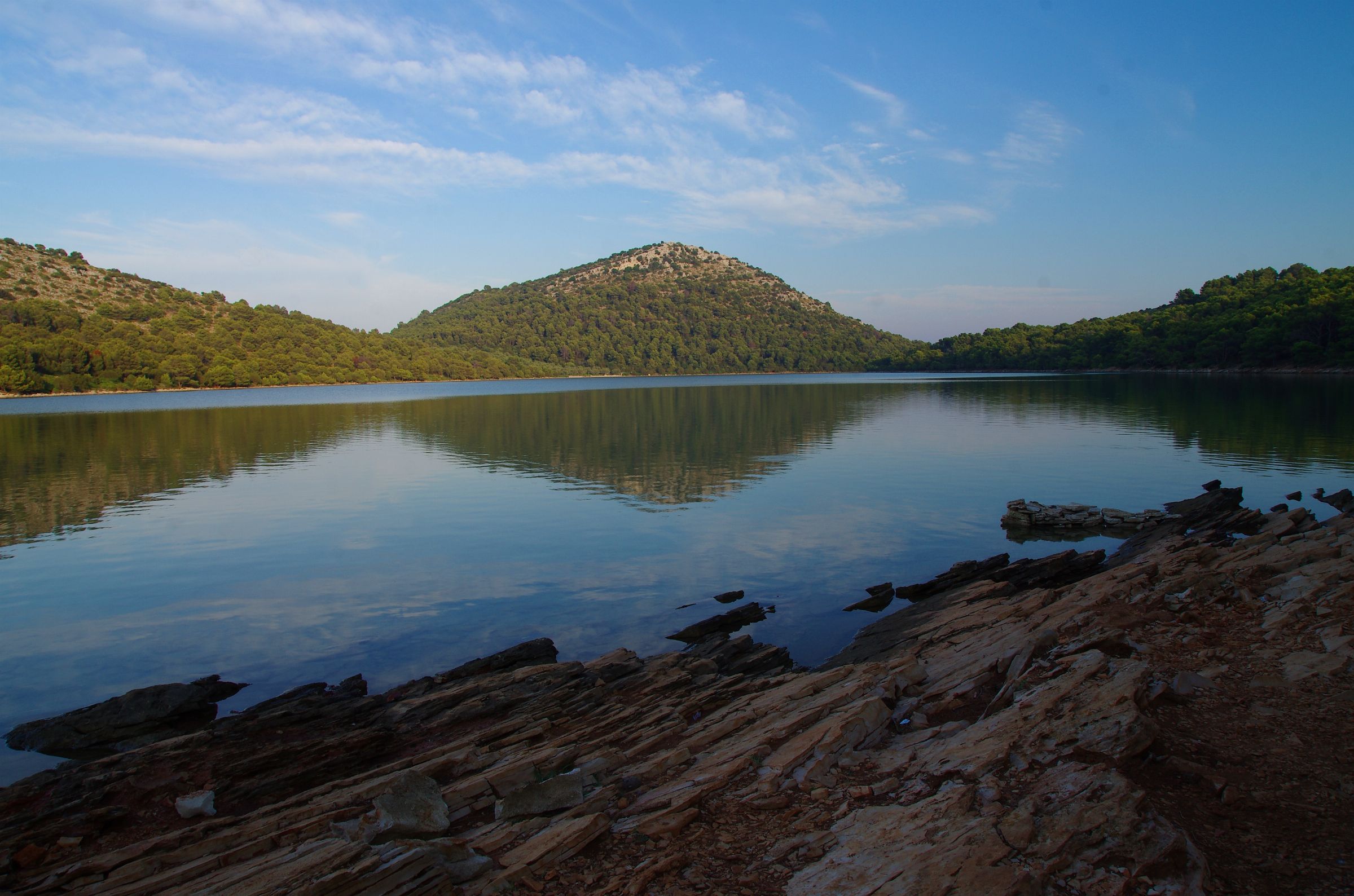
 The salt lake Mir, one of the three fundamental phenomena of Telašćica. Photo: Wikimedia Commons (source file)
Telašćica bay: a harbour of peace
The heart of the park is the bay of Telašćica itself — a deep, indented sea inlet that stretches several kilometres into the land and in fact consists of three smaller, connected coves. Because of its depth, shelter and calm it is considered one of the largest and safest natural harbours on the whole Adriatic — a refuge in which ships of all kinds find shelter from bad weather.
The bay itself is surrounded by thirteen islands and islets, six of which lie within it, and its shores hide as many as twenty-five small beaches. While one side of the bay is bare and stony, the other is covered by a dense forest of pine, olive and fig. The name "Telašćica" comes from an old name referring to three connected lakes — for that is exactly how this unique bay looks, like a series of connected stretches of water.
The cliffs: sheer faces above the sea
If the bay is the face of peace, then the cliffs are the face of wilderness. On the side facing the open sea, Dugi Otok plunges in sheer cliffs that rise as much as one hundred and sixty metres above the sea, and then continue falling another ninety metres or so into the depths. These dramatic rocky formations, which the locals simply call "the cliffs", are one of the most impressive sights on the whole Croatian coast.
To stand on the edge of these cliffs, with the sea foaming far below and the endless blue of the Adriatic before you, is a breathtaking experience. The best view is from the viewpoint at the old fortress of Grpašćak, where an information centre has been set up. From there, alongside the very cliffs, the neighbouring Kornati and the open sea can also be seen — a panorama that has made Telašćica one of the most photographed places on the Adriatic.
Lake Mir: a salt secret
Between the bay and the open sea, on a narrow strip of land, hides the third and perhaps most unusual phenomenon of the park — the salt lake Mir. This lake, about nine hundred metres long, has no visible connection to the sea, yet it is salty — even saltier than the surrounding sea — because it is connected to it by underground cracks, and strong evaporation further increases its salinity.
Lake Mir is also known for the healing properties of its mud and warm, shallow water, so people gladly bathe in it and coat themselves with mud. Surrounded by pine forest and rocky ground, calm and warm, the lake truly lives up to its name ("mir" means peace). Along its shores donkeys can often be seen too, once indispensable companions of island life, which have become one of the endearing symbols of Telašćica.
A seabed full of life
The beauty of Telašćica does not end at the surface. Its sea, part of the same protected system as the Kornati, is exceptionally rich in life — several hundred plant and animal species have been recorded in it. The bottom is covered by vast meadows of Posidonia, a marine flowering plant that is the true lung of the Adriatic, while among the rocks and in the cracks hide countless fish, shellfish and other organisms.
Bottlenose dolphins occasionally appear in these waters, and sometimes the loggerhead turtle too, an endangered sea turtle. Because of that rich and well-preserved underwater nature, Telašćica is a favourite destination for divers, who along the steep underwater rocks discover a world as dramatic as the one above the surface. The protection of the seabed is one of the main reasons the whole area is under a strict regime.
Mediterranean nature and silence
On the terrestrial part of the park, two worlds alternate: lush forests of Aleppo pine and holm oak on one side and bare, sunny rocky ground on the other. In this area grow around five hundred plant species, among them endemic and endangered ones, adapted to the dry, sunny climate. Alongside them stretch cultivated fields with olive groves and vineyards, witnesses to centuries of island life.
The sky of Telašćica is circled by gulls, kestrels and falcons, which nest on inaccessible cliffs. That mixture of wilderness and traditional landscape, silence and sea, gives the park a special, almost meditative atmosphere. Telašćica is not a place of noise and crowds but a space where only the sea, the wind and the occasional cry of a bird are heard — a corner of peace ever rarer on the Adriatic.
Traces of the past
Although it seems today like untouched wilderness, Telašćica has been inhabited for thousands of years. This is testified by the remains of Roman buildings and numerous small, pre-Romanesque churches scattered across the island. From these shores come some of the oldest written records of fishing among the Croats, proof that people here have lived in harmony with the sea since time immemorial.
Through the centuries, life on Telašćica and the surrounding Kornati was based on sheep-farming, olive-growing and viticulture — activities that, fortunately, shaped the landscape without disturbing its natural balance. It is precisely that harmony of man and nature, kept almost unchanged to this day, that is part of what makes Telašćica so valuable and special.
Through the seasons
Telašćica is a sun-drenched destination. Spring wakes the Mediterranean herbs and brings pleasant temperatures ideal for walking along the cliffs and bathing in Lake Mir. Summer is the height of the season — the sea is warm, the lake pleasant and the bay full of yachtsmen; still, the sun on the bare stone is strong, so water and shade are welcome. Autumn brings a clear sea, calmer beaches and warm colours. Winter is mild but windy, when the park falls quiet and shows its wild, solitary face.
Part of a great marine whole
Telašćica cannot be fully understood apart from its neighbours. Together with the Kornati it forms a single natural and scenic whole — the same karst world of bare, white islands scattered across the blue, shaped by the same geological processes over tens of millions of years. That is why a visit to Telašćica is most often combined with a tour of the Kornati, with which it shares both the sea and the story.
That exceptional value has been recognised at the highest level too: the Kornati and Telašćica together are on the Croatian list of candidates for UNESCO World Heritage. The reason is clear — few places in the world have such a rich mosaic of islands, cliffs, bays and seabed, preserved in an almost untouched state despite a thousand years of human presence. Telašćica is thus not a solitary jewel but part of one of the most valuable marine wholes of the entire Mediterranean.
A few curiosities to close
Telašćica abounds in peculiarities that surprise. Its bay is considered the largest and safest natural harbour on the whole Adriatic, with as many as twenty-five small beaches. Its "cliffs" rise up to one hundred and sixty metres above the sea and fall almost as deep below the surface. The salt lake Mir is saltier than the surrounding sea, and its mud is prized for its healing properties. And the name Telašćica comes from an old name referring to three connected lakes — for that is exactly how its indented bay looks.
All this makes Telašćica a park in which the most contrasts meet in the smallest space — peace and wilderness, fresh and salt, land and sea — a summary of everything for which the Croatian Adriatic is renowned.
A practical guide to visiting
- Getting there. The park lies in the south-east of Dugi Otok, reached by ferry from Zadar (to Brbinj or Božava). Telašćica is approached by land from the island or by sea, by boat.
- Tickets and information. An entrance ticket is charged; seek information, maps and guided tours at the Grpašćak information centre and the park administration.
- Sights. Do not miss the Grpašćak viewpoint and the cliffs, the salt lake Mir and a walk along the bay; bathing in Lake Mir is a special experience.
- Getting around. The park is explored on foot, by bicycle and by boat; many visit it as part of a boat excursion from Zadar or from the Kornati.
- Footwear and gear. Comfortable shoes for the stony trails, sun protection and enough water are essential; a swimsuit for the lake and the bay.
- Rules. Move on marked trails, do not approach the cliff edge too closely, do not disturb the animals and respect the strict protection of the sea and the lake.
- Combine with the surroundings. Kornati National Park, Sakarun beach on Dugi Otok and the city of Zadar make Telašćica a perfect part of an island journey.
Conclusion
Telašćica is a park of contrasts rarely met — a calm, safe bay and wild cliffs above the sea, the sweet silence of the pine forest and a salt, healing lake, ancient human presence and untouched nature. In a small space at the end of Dugi Otok it has condensed almost everything for which the Adriatic is beautiful, and added what makes it unique. Whether you stand on the edge of the cliffs, swim in the warm Lake Mir or sail into the safest harbour of the Adriatic, Telašćica welcomes you as its name says — with a peace remembered for a lifetime.